The cost of complying with the Region 4 Commercial, Industrial, and Institutional Stormwater Permit cannot be reduced to one fee or per-acre price. Order R4-2026-0226 requires baseline activities that apply before a facility implements its selected compliance option. Each option can then introduce different contribution, infrastructure, monitoring, and maintenance expenses.
The permit was adopted on July 23, 2026, and becomes effective on October 31, 2026. Cost figures discussed below come primarily from the Water Board’s Fact Sheet and should be treated as regulatory planning estimates rather than current vendor pricing. 1
The Water Board’s Fact Sheet provides useful economic-analysis figures for planning, but they are not SoCal Stormwater Solutions prices, contractor bids, laboratory quotes, or guaranteed facility budgets. A defensible estimate requires verified site information, including impervious area, receiving water, drainage configuration, existing controls, likely sampling locations, and feasible compliance options.

TL;DR
There is no single CII stormwater compliance cost. A facility’s budget can include the annual regulatory fee, SWPPP and enrollment work, initial sampling, minimum BMPs, administration, and compliance-option costs.
Section 3.3 requires an annual fee under California Code of Regulations, title 23, section 2200 et seq. The applicable amount must be checked against the current fiscal-year fee schedule.1 2
The Water Board Fact Sheet estimates one-time initial monitoring and analysis at approximately $1,535. This is a regulatory economic-analysis estimate, not a current laboratory quote.
Table F-6 provides planning estimates of approximately $4,100 per impervious acre for Option 1, $21,655–$24,694 per impervious acre for Option 2, and $660–$30,666 per impervious acre for Option 3.1
The lowest headline estimate is not automatically the best or available option. Technical feasibility, receiving water, drainage, infrastructure, pollutant profile, space, and long-term operation and maintenance can change the decision.
How much does Region 4 CII stormwater compliance cost?
The total CII permit cost is a stack of regulatory, technical, operational, and option-specific expenses. Two facilities with similar parcel sizes may have materially different budgets because they drain to different receiving waters, have different numbers of discharge locations, or need different stormwater controls.
What Makes Up the Cost of Region 4 CII Compliance? |
|||
|---|---|---|---|
| Cost Layer | One-Time or Recurring | What Drives It | Does the Water Board Publish an Estimate? |
| Annual Regulatory Fee | Recurring | Applicable Fiscal-Year Title 23 Fee Schedule | The fee is required, but the current schedule must be checked. 1 2 |
| Applicability and Site Review | Primarily One-Time; Updates May Be Needed | Parcel Structure, Permit Status, Acreage, Watershed, and Site Complexity | No site-specific professional-services estimate |
| SWPPP and Enrollment | Initial Setup; Revisions May Recur | Facility Complexity, Drainage, Pollutant Sources, Maps, and Records | No site-specific consultant quote |
| Initial Sampling | Initial | Receiving Water, Parameters, Discharge Locations, Field Logistics, and Laboratory Rates | Approximately $1,535 as a Water Board planning estimate. 1 |
| Minimum BMPs and Training | Recurring; Capital Work May Also Occur | Existing Controls, Facility Size, Staffing, Pollutant Exposure, and Deficiencies | Fact Sheet discusses assumptions, but not a universal facility price |
| Option 1 Contribution | Recurring While Using Option 1, According to the Agreement | Impervious Area, Runoff Volume, WMP Costs, Agreement, and Fee Structure | Approximately $4,100 per impervious acre in Table F-6. 1 |
| Option 2 Controls | Capital Plus Recurring O&M | Design Volume, Infrastructure, Space, Engineering, Pretreatment, Construction, and Maintenance | Approximately $21,655–$24,694 per impervious acre in Table F-6. 1 |
| Option 3 Monitoring and Controls | Recurring; Capital Costs May Arise | Receiving Water, Pollutants, Sampling Points, Laboratory Work, and Additional BMP Needs | Approximately $660–$30,666 per impervious acre in Table F-6. 1 |
All dollar figures in the final column are Water Board planning or economic-analysis estimates. They should not be multiplied by acreage and presented as a final budget without confirming the applicable cost unit and site assumptions.
Which costs apply before you even choose a Compliance Option?
The Permit Registration Documents required under the General Permit consist of the NOI, site-specific SWPPP, initial-sampling laboratory analytical results, and applicable Compliance Option Documents, together with the annual fee. For existing Dischargers, the permit establishes different submittal deadlines for these requirements, so the associated costs may arise at different stages of implementation. 1
Baseline budget categories can include:
- Applicability and property-record review
- Site assessment and drainage evaluation
- NOI and SMARTS enrollment support
- Site-specific SWPPP preparation
- Site mapping and pollutant-source evaluation
- Initial sampling and laboratory analysis
- Minimum BMP implementation
- Employee training
- Visual observations and documentation
- Recordkeeping and annual reporting
- Ongoing BMP inspection, maintenance, and corrective action
Ongoing budgeting should also account for annual reporting. Regardless of the Compliance Option selected, the permit requires an annual report through SMARTS by December 15 of each reporting year, along with the option-specific monitoring or reporting requirements that apply. 1
Facilities comparing existing industrial controls with the new requirements can review Industrial SWPPP Services. Existing equipment, records, and procedures may inform the planning process, but they should not be assumed to satisfy the new CII Permit without a requirement-by-requirement review.
Annual Regulatory Fee
Section 3.3 requires the Discharger to pay the applicable annual fee under California Code of Regulations, title 23, section 2200 et seq. 1
The State Water Board adjusts water-quality regulatory fee schedules by fiscal year. As of September 2026, the Water Quality Fees page provides the applicable fee resources for NPDES stormwater programs, and the State Water Board adopted Resolution 2026-0038 on September 15, 2026, revising core water-quality regulatory fee schedules for FY 2026–27. 2 3 Because the CII Permit becomes effective October 31, 2026, the applicable CII annual fee should be verified against the operative Title 23 fee schedule and current Water Board guidance when enrollment occurs. An Industrial, Construction, or other stormwater permit fee should not be assumed to be the applicable CII fee.
Initial Sampling
The Fact Sheet estimates the one-time cost of initial monitoring and analysis for applicable Water Quality Objectives at approximately $1,535. 1
That figure is a planning reference. Actual costs may differ based on current laboratory rates, analytical parameters, field labor, equipment, access, courier requirements, weather, discharge availability, and the number of representative locations. Initial sampling must also be distinguished from recurring Option 3 monitoring.
How much can Compliance Option 1 cost?
Compliance Option 1 requires a legally binding agreement with the applicable Watershed Management Group or its designated Fiduciary Agent to contribute funding to an existing or planned suite of regional projects identified in the group’s WMP. 1 Participation is limited by the permit’s modeled-area and project requirements and should not be assumed available to every facility.
Table F-6 provides an illustrative Option 1 estimate of approximately $4,100 per impervious acre. 1 The underlying Fact Sheet calculation estimates $4,100 per acre-inch in 2025 dollars, based on an assumed one-inch event and a Dominguez Channel watershed example. 1
The figure is not a published universal contribution rate. Watershed Management Groups may develop fee structures using the equation established in Section 8.1. Actual cost can depend on:
- The facility’s applicable runoff or impervious-area measure
- Onsite low-impact-development reductions
- Total Watershed Management Program costs
- Available regional projects
- Agreement terms and administrative expenses
- Updates to WMPs and reasonable assurance analyses
A facility must verify eligibility, the available agreement structure, and the actual contribution before using Option 1 in an operating budget.
Why can Compliance Option 2 be the most capital-intensive path?
Option 2 requires facility-specific stormwater controls with effective capacity to address authorized non-stormwater discharges and runoff produced up to and during an 85th-percentile, 24-hour storm event. Depending on the design, controls may capture and use, infiltrate, divert to the sanitary sewer, or evapotranspire applicable flows. 1
Table F-6 gives an economic-comparison estimate of approximately $21,655–$24,694 per impervious acre for Option 2. 1 This is an annualized comparison figure, not the upfront construction price.
The underlying Fact Sheet analysis separately estimates:
- Capital costs of approximately $285,000–$325,000 per acre-inch in 2023 dollars. 1
- Annual O&M equal to an assumed 1.5% of capital cost, producing an estimated $4,275–$4,875 per acre-inch annually. 1
- Annualized BMP costs of approximately $21,107–$24,069 per acre-inch, based on a 20-year lifecycle and a 2% discount rate. 1
The analysis states that its capital estimate does not include pretreatment BMPs. Site-specific costs may also include engineering, hydrologic and hydraulic calculations, geotechnical evaluation, permitting, utility conflicts, construction access, sanitary-sewer coordination, testing, maintenance, and eventual rehabilitation.
Available space, infiltration feasibility, groundwater-protection requirements, existing drainage, and planned redevelopment can substantially affect Option 2 feasibility and lifecycle cost. The capital estimate, annual O&M estimate, and annualized comparison should remain separate in budgeting.
Why does Compliance Option 3 have the widest cost range?
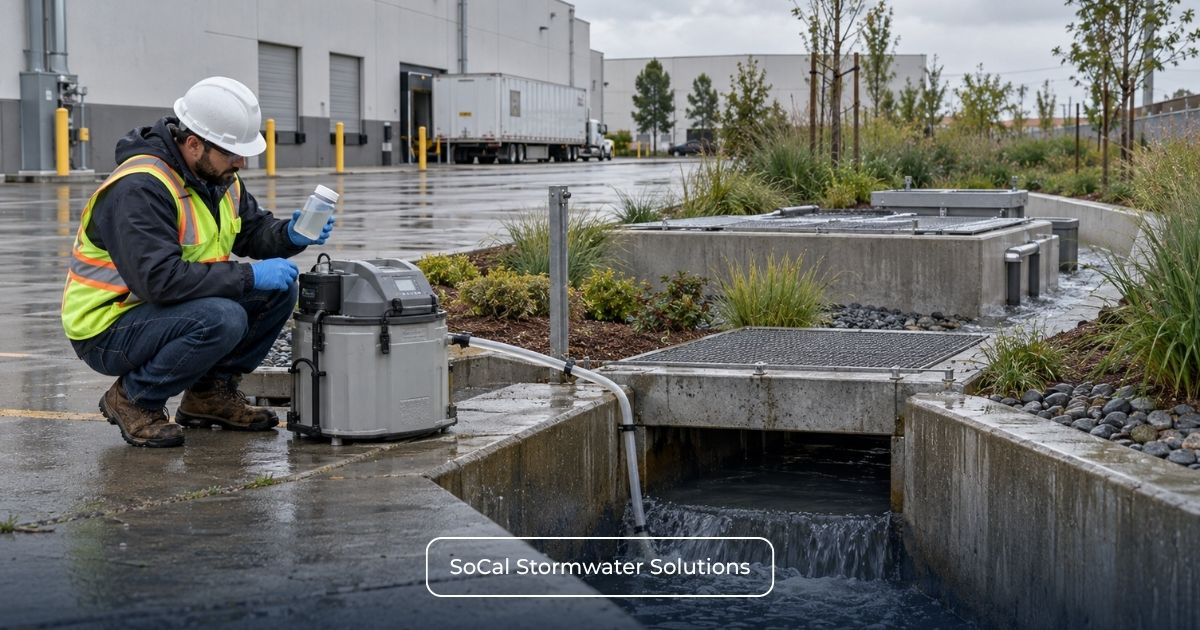
Option 3 uses monitoring and reporting to demonstrate direct compliance with applicable water quality-based effluent limitations. Table F-6 estimates approximately $660–$30,666 per impervious acre. 1
The low end assumes monitoring without additional controls beyond the required minimum BMPs. The high end assumes controls similar to those associated with Option 2, plus monitoring. A facility should not assume that the low-end scenario will be technically sufficient. For the Table F-6 comparison, the Fact Sheet assumes one sampling site per acre and expressly notes that this overestimates the number of samples that would need to be collected per site. 1
Option 3 cost drivers include:
- The receiving water and applicable analytical suite
- The number of drainage areas and discharge locations
- Four required Qualifying Storm Event sampling events per reporting year 1
- Sampling access and safety
- Laboratory and courier charges
- Field instruments and calibration
- Staff or consultant time
- Data review and SMARTS reporting
- Corrective actions and added BMPs if needed
The Fact Sheet estimates preparation of a site-specific Monitoring and Reporting Plan at approximately $4,077–$10,192. 1 It also estimates annual laboratory monitoring at approximately $660–$5,972, depending on the receiving waterbody. 1
These figures rely on historical wage, laboratory, and dollar-adjustment assumptions described in the Fact Sheet and are not current vendor quotes.
Facilities evaluating sampling logistics and operational workload can review Industrial Inspections and Monitoring.
Compact Compliance-Option Cost Comparison |
|||
|---|---|---|---|
| Option | Water Board Table F-6 Estimate | Primary Cost Structure | Important Limitation |
| Option 1 | About $4,100 per Impervious Acre 1 | Watershed Management Group Contribution | Eligibility, Project Availability, and Actual Fee Structure Require Verification |
| Option 2 | About $21,655–$24,694 per Impervious Acre 1 | Structural Controls, Engineering, Construction, and O&M | Annualized Comparison Is Not the Upfront Capital Cost |
| Option 3 | About $660–$30,666 per Impervious Acre 1 | MRP, Recurring Monitoring, Reporting, and Possibly Additional BMPs | Monitoring-Only Assumptions May Not Fit Every Facility |
What costs are commonly missed in a CII budget?
A budget based only on a permit fee, laboratory estimate, or construction price can omit material lifecycle expenses. Potentially overlooked items include:
- Engineering and design revisions
- Pretreatment required before infiltration or reuse
- Permits and utility coordination for structural work
- Sampling equipment, mobilization, and weather scheduling
- Staff time for training, observations, and recordkeeping
- SMARTS administration and annual reporting
- BMP inspections, cleaning, repairs, and replacement
- Laboratory resampling or additional analysis
- Corrective-action implementation
- Access improvements at discharge locations
- Long-term O&M contracts
- Rehabilitation or replacement of structural controls
These items should not automatically be added on top of every Water Board estimate. Some may already be included within the Fact Sheet’s assumptions, while others may be additional site-specific expenses. The budget should document what each estimate covers to avoid omissions or double counting.
How to Build a Site-Specific CII Compliance Budget
A site-specific budget should begin only after applicability is reasonably established. If coverage remains uncertain, first evaluate the Region 4 CII Permit 5-acre threshold and other coverage gates.
As a practical, non-exclusive budgeting framework, not a Water Board-prescribed cost-estimation procedure, the review can document:
- The site address, APN, ownership, and current permit status.
- Total and applicable impervious acreage.
- The receiving water and applicable pollutant requirements.
- Drainage areas and potential sampling locations.
- Existing BMPs, drainage infrastructure, and known deficiencies.
- Initial-sampling access and laboratory needs.
- Option 1 eligibility and preliminary agreement information.
- Option 2 space, infrastructure, engineering, and O&M feasibility.
- Option 3 monitoring locations, analytical suite, and potential BMP needs.
- Capital constraints and the facility’s ability to maintain controls.
- The current annual regulatory fee.
- Professional services, SMARTS administration, training, reporting, and contingency needs.
If responsibility for the budget is divided between the owner and operator, review Region 4 CII Permit owner-or-tenant responsibility before finalizing the enrollment and implementation structure.
SoCal Stormwater Solutions can evaluate the site information used to build a CII compliance planning budget, including impervious area, drainage, receiving water, sampling locations, existing controls, and the practical requirements of the three compliance options. The result should be treated as site-specific planning support rather than a guaranteed regulatory or construction outcome.
To request a technical CII compliance budget and option review, provide the property address and APN, current permit status, estimated impervious acreage, drainage or site plans, known receiving water, existing stormwater controls, and any available sampling information.
After applicability and enrollment roles have been established, SMARTS Permitting and Application Services can support applicable electronic permitting and reporting workflows.