No. A valid No Exposure Certification under California’s Industrial General Permit does not create a blanket exemption from the Region 4 Commercial, Industrial, and Institutional Stormwater Permit.
An NEC addresses whether industrial materials and activities remain protected from stormwater exposure under the Industrial General Permit. The CII Permit separately evaluates designated stormwater runoff from qualifying privately owned properties in two specified watersheds. For an NEC facility, that evaluation includes location, CII site status, ownership, total acreage, parcel configuration, and any applicable permit exception.
Order R4-2026-0226 became effective on October 31, 2026. Facilities should evaluate the requirements of both programs before changing their existing IGP status or preparing CII enrollment documents. 1

TL;DR
- A valid No Exposure Certification does not automatically exempt a qualifying facility from the Region 4 CII Permit.
- The adopted CII Order uses a five-or-more-acres-of-total-area branch for qualifying sites addressed under Section 3.1.3 and expressly addresses facilities with an IGP NEC in Section 3.1.3.1.
- When the other CII applicability requirements are met, section 3.1.3.1 requires CII coverage for the acreage covered by the NEC.
- Obtaining CII coverage does not automatically cancel or replace the NEC. The Industrial General Permit and CII Permit address different regulatory questions and must be evaluated separately.
Does a No Exposure Certification exempt a facility from the Region 4 CII Permit?
A valid NEC does not, by itself, answer whether a property needs coverage under the Region 4 CII Permit.
Section 3.1.3 of the adopted Order addresses qualifying CII sites already covered by another NPDES stormwater permit. This branch uses a threshold of five or more acres of total area, rather than the five-acre impervious-surface test applied to qualifying CII sites without other NPDES stormwater coverage.
Section 3.1.3.1 then addresses NEC facilities directly. When a facility meets the other CII applicability requirements, it must obtain CII coverage for the acreage covered by its NEC. 1
That rule does not mean every facility with an NEC needs CII coverage. The property must still:
- Be within the Dominguez Channel/Los Angeles and Long Beach Inner Harbor Watershed or the Los Cerritos Channel/Alamitos Bay Watershed.
- Meet the permit’s definition of a qualifying privately owned CII site.
- Fall within the applicable ownership and property provisions.
- Have five or more acres of total area under the existing-NPDES branch.
- Not qualify for a specific permit exclusion.
An NEC Is Not a CII Exemption
An NEC and the Region 4 CII Permit evaluate different aspects of stormwater regulation. The comparison below shows what each program assesses, how acreage is treated, and why maintaining valid no-exposure status under the IGP does not independently resolve CII applicability.
Valid NEC
↓
Preserve the facility’s qualifying IGP no-exposure status
↓
Apply the separate CII location, site, ownership, and five-acre total-area tests
↓
If all CII requirements are met, obtain CII coverage for the NEC acreage
The practical conclusion is not “cancel the NEC” or “automatically enroll the entire property.” It is to document how the two programs apply to the actual site.
What does an NEC actually do under California’s Industrial General Permit?

A No Exposure Certification is an Industrial General Permit status available when qualifying industrial materials and activities are protected from exposure to rain, snow, snowmelt, and runoff in accordance with the permit’s no-exposure conditions.
A valid NEC provides a conditional exclusion from the IGP’s standard SWPPP and monitoring requirements for qualifying industrial stormwater discharges. To maintain this status, the Discharger must preserve the required no-exposure conditions and complete annual electronic recertification through SMARTS. 2 3
The current Industrial General Permit, Order 2014-0057-DWQ as amended, remains administratively continued until a replacement permit becomes effective. Its original expiration date does not make existing IGP or NEC requirements inactive. 2
An NEC is a facility-wide conditional exclusion under the IGP, rather than a status that can be independently assigned to individual drainage areas or discharge locations. Its documented facility boundary must therefore be distinguished from the potentially broader property area evaluated under the CII Permit. 2
An NEC therefore remains meaningful. It documents a facility’s qualifying no-exposure status under the IGP. What it does not do is create an exemption from every other stormwater permit that may apply to the property.
Facilities evaluating their current IGP status can review Industrial SWPPP Services for support with permit records, site conditions, and applicable industrial compliance documents.
NEC and CII Permit Questions Compared
Key Differences Between an IGP NEC and Region 4 CII Permit Coverage |
||
|---|---|---|
| Decision Layer | Industrial General Permit / NEC | Region 4 CII Permit |
| Regulatory Question | Are regulated industrial materials and activities exposed to stormwater? | Is runoff from a qualifying designated CII site subject to separate NPDES coverage? |
| Geographic Test | The Region 4 CII watershed boundary is not an NEC eligibility test. | The site must be within one of the two designated watershed areas. |
| Acreage Test | NEC eligibility is not based on the CII five-acre threshold. | Qualifying NEC facilities enter the branch based on five or more acres of total area. |
| Effect of NEC | Provides a conditional exclusion from the IGP’s standard SWPPP and monitoring requirements while all applicable NEC conditions are maintained. | Does not establish a general CII exemption. |
| Covered Acreage | Applies on a facility-wide basis under the IGP, with the relevant facility acreage documented in the NEC records. | Section 3.1.3.1 requires coverage for NEC acreage when all CII applicability requirements are met. |
| Administration | Maintain NEC conditions and applicable SMARTS recertification. | Complete separate CII enrollment and compliance requirements when applicable. |
Why does the CII Permit still apply to some NEC facilities?
The two programs address different stormwater questions. An NEC evaluates whether regulated industrial materials and activities are exposed to stormwater under the IGP. The CII Permit separately addresses designated runoff from qualifying commercial, industrial, and institutional sites.
Sheltering industrial materials can preserve valid NEC status, but it does not necessarily eliminate runoff from rooftops, parking areas, driveways, vehicle areas, or other site surfaces. The Los Angeles Water Board therefore did not establish NEC status as a general exemption from the CII Permit. Instead, Section 3.1.3.1 specifically addresses how qualifying NEC facilities are treated under the CII coverage rules. 4
Does CII coverage cancel or replace the NEC?
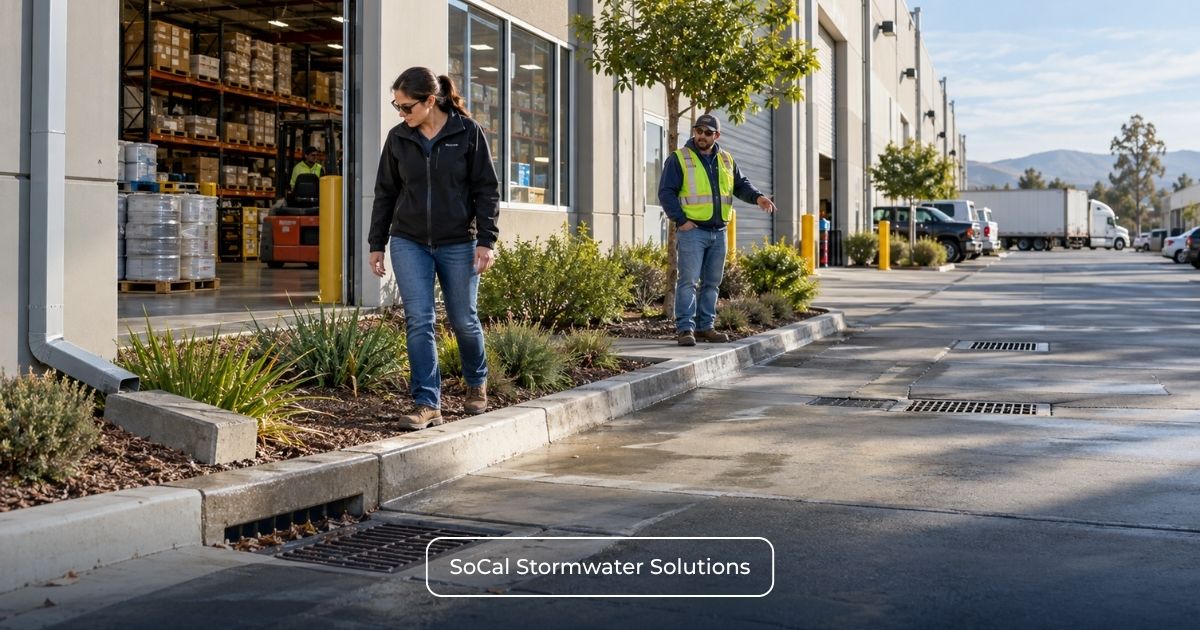
No. CII applicability does not automatically cancel, void, or replace a facility’s NEC.
An operator should evaluate its continuing NEC obligations under the IGP separately from any CII coverage required under Section 3.1.3.1. The applicable requirements depend on the facility’s documented status, boundaries, and operating conditions.
Facility operators should not terminate or alter an NEC solely because a preliminary review indicates possible CII applicability. Doing so without mapping both programs could create a gap in the facility’s industrial stormwater documentation.
As a practical, non-exclusive review framework, the following records and site conditions can help clarify the relationship between the two programs:
- The facility boundary shown in SMARTS.
- The acreage covered by the NEC.
- The parcels and contiguous areas included in the CII analysis.
- Areas covered by any other NPDES stormwater permit.
- Roof, parking, driveway, loading, waste, and common-area drainage.
- Current no-exposure controls and operating conditions.
- The ownership and operator structure associated with each permit record.
Industrial Inspections and Monitoring can support the review of existing industrial field conditions, drainage areas, exposure controls, and monitoring-related records. The regulatory determination should still be based on the adopted permit language and the facility’s documented circumstances.
Which NEC facilities still fall outside the CII Permit?
An NEC does not create a blanket CII exemption, but an NEC facility can remain outside this specific permit when it does not pass the underlying applicability gates.
Location Outside the Two Watersheds
The permit applies only within the Dominguez Channel/Los Angeles and Long Beach Inner Harbor Watershed and the Los Cerritos Channel/Alamitos Bay Watershed. A Los Angeles County address alone does not establish coverage.
Property Outside the CII Site Definition
The property must satisfy the permit’s applicable private-ownership, CII site, and land-use classification requirements. The adopted Order excludes residential facilities, while the qualifying commercial, industrial, and institutional classifications are defined through specified Los Angeles County Assessor land-use codes. 1
Less Than Five Acres of Total Area
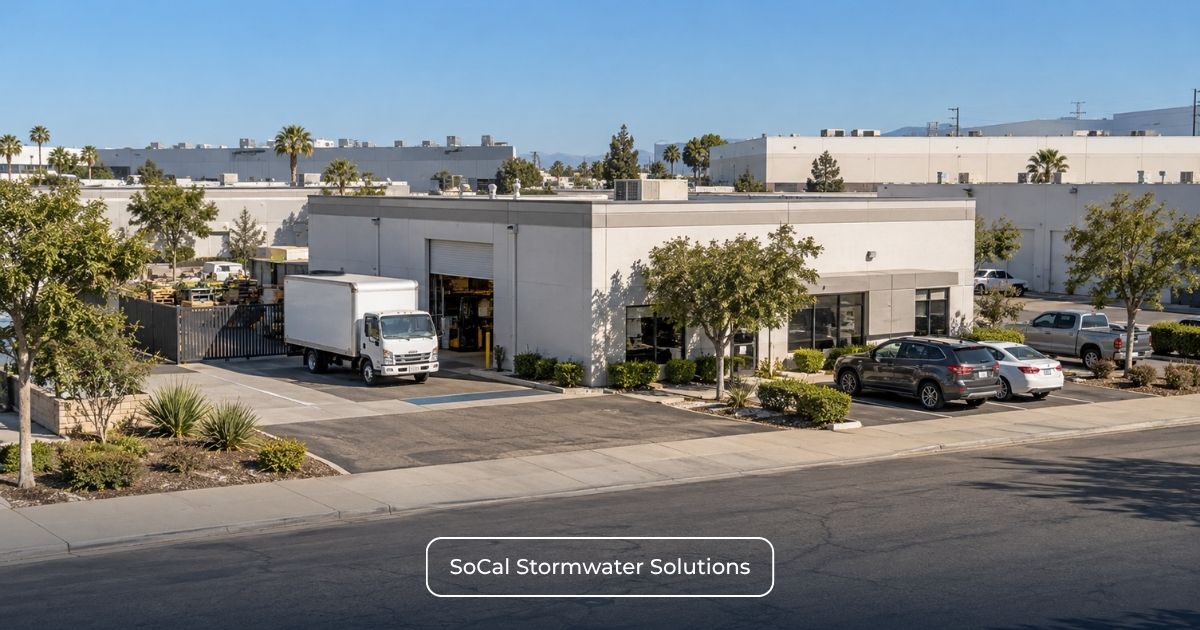
Under Section 3.1.3, qualifying sites in this existing-permit branch are evaluated using five or more acres of total area, with NEC facilities specifically addressed in Section 3.1.3.1. A smaller NEC facility does not automatically require CII coverage merely because it lies within a designated watershed.
Total area should not be substituted with impervious acreage in this branch. Parcel boundaries, contiguous parcels, campus arrangements, facility boundaries, and the scope of existing permit coverage may affect the analysis.
A Specific Permit Exclusion Applies
A facility may remain outside the General Permit when it meets an exact exclusion stated in the adopted Order. For example, the Order addresses facilities covered by an individual NPDES permit containing requirements at least as stringent as the CII Permit. Exclusions should be applied from their actual language rather than inferred from NEC status.
The complete methodology for parcel configuration and acreage belongs in the separate Region 4 CII Permit 5-Acre Threshold: Does Your Property Need Coverage? article. The NEC-specific conclusion remains narrower: five or more acres of total area is one required gate, not the only gate.
What should an NEC facility do before CII enrollment?
Order R4-2026-0226 became effective on October 31, 2026. Existing and new dischargers then follow the applicable enrollment schedules established by the Order. Under Section 3.4.1, Existing Dischargers seeking coverage must submit a complete NOI and site-specific SWPPP within 12 months of the effective date, initial-sampling laboratory analytical results within 18 months, and Compliance Option Documents within three and one-half years. 1 5
New Dischargers follow a different schedule. Section 3.4.2 requires the NOI, SWPPP, initial-sampling analytical results, and Compliance Option Documents at least 45 days before commencement of the authorized discharge. 1
Before filing new documents or changing the existing NEC, assemble:
- The facility address and parcel information.
- Confirmation of the applicable watershed and drainage destination.
- Total site acreage and the basis used to calculate it.
- The property’s CII land-use classification.
- Ownership, operator, tenant, and contiguous-parcel information.
- The NEC identification number and current SMARTS record.
- A map showing the acreage covered by the NEC.
- Records supporting current no-exposure conditions.
- Any NOI, NONA, individual permit, or other NPDES coverage.
- Roof, parking, driveway, loading, common-area, and discharge-point information.
- The site map and documents needed to evaluate future CII enrollment.
Clarify NEC and CII Coverage Requirements
An existing NEC should be evaluated alongside the CII Permit’s separate applicability provisions before changes are made to the facility’s industrial stormwater status. Documented facility boundaries, total acreage, watershed location, ownership, and existing permit records are relevant to that assessment.
For related permitting assistance, review SMARTS Permitting and Application Services or contact SoCal Stormwater Solutions.