An industrial facility’s existing stormwater status does not necessarily resolve whether separate Region 4 CII Permit requirements apply. The correct analysis compares the boundaries of the current IGP, NEC, NONA, or individual permit with the full qualifying CII site.
Order R4-2026-0226 expressly addresses facilities already covered by another NPDES stormwater permit. It also establishes separate rules for NEC acreage, acreage outside a NONA, and portions of a facility not covered by another permit. The practical task is to determine which acres are already regulated under each status and which areas remain subject to CII evaluation.
The CII Permit has been adopted and is listed as active in the Water Board’s permit record, but it does not become effective until October 31, 2026. 1

TL;DR
- Existing Industrial General Permit coverage does not automatically exempt an entire facility from the Region 4 CII Permit.
- Qualifying CII sites covered by another NPDES stormwater permit use the 5 or more acres of total area threshold branch.1
- For qualifying CII sites subject to Section 3.1.3, facilities with an IGP NEC must obtain CII coverage for the acreage covered by the NEC, while facilities with an IGP NONA must obtain CII coverage for acreage not covered by the NONA.1
- If another NPDES stormwater permit covers only part of an otherwise applicable facility, the CII Permit requires coverage for the remaining portion.1
- A facility with an individual NPDES permit does not require separate CII coverage only when that permit contains requirements at least as stringent as the CII Permit.1
Does Existing IGP Coverage Exempt a Facility From the Region 4 CII Permit?
Not necessarily. Existing IGP coverage does not create a blanket facility-wide exemption from the Region 4 CII Permit.
Section 3.1.3 covers qualifying CII sites that are already covered by another NPDES stormwater permit and have five or more acres of total area. This differs from the branch for CII sites not covered by another NPDES stormwater permit, which uses five or more acres of impervious surface. 1
This article focuses on how existing permits overlap. The separate Region 4 CII Permit 5-acre threshold guide explains the two acreage tests in more detail.
A facility must still satisfy the CII Permit’s other applicable site, ownership, land-use, watershed, acreage, and coverage criteria. It must qualify as a privately owned CII site and fall within either:
- The Dominguez Channel/Los Angeles and Long Beach Inner Harbor Watershed
- The Los Cerritos Channel/Alamitos Bay Watershed
The facility must then compare its full qualifying area against the actual boundaries and status of its existing permit coverage.
How Existing Stormwater Coverage Affects CII Permit Requirements |
||
|---|---|---|
| Existing Status | What the Adopted CII Permit Provides | Required Coverage Review |
| IGP or Other NPDES Stormwater Coverage | The Existing-Permit Branch Uses Five or More Acres of Total Area | Identify Which Portions Are Actually Covered by the Existing Permit |
| NEC | CII Coverage Is Required for the Acreage Covered by the NEC When the CII Applicability Criteria Are Met | Map the NEC Footprint and Verify the Site and Watershed Gates |
| NONA | CII Coverage Is Required for Acreage Not Covered by the NONA When the CII Applicability Criteria Are Met | Identify What the NONA Covers and What Remains Outside It |
| Partial NPDES Coverage | The Remaining Portion of the Facility Requires CII Coverage When Otherwise Applicable | Compare the Existing Permit Boundary with the Full Qualifying CII Site |
| Individual NPDES Permit | Separate CII Coverage Is Not Required if the Individual Permit Is at Least as Stringent as the CII Permit | Review the Individual Permit’s Actual Requirements Before Claiming Exclusion |
California’s current Industrial General Permit is Order 2014-0057-DWQ, as amended in 2015 and 2018, with NPDES Permit No. CAS000001. Although its stated expiration date was June 30, 2020, the State Water Board confirms that it remains administratively continued until a new permit is issued. 2
How does the CII Permit treat areas already covered by the IGP?
The existing IGP and the new CII Permit should not be treated as interchangeable programs or assumed to regulate identical site boundaries.
The CII Permit Fact Sheet explains that EPA’s residual designation reaches portions of certain industrial facilities that are not covered by the IGP, giving parking lots and rooftops as examples. 1 Other site areas may also warrant review where the facility’s current permit records show that they fall outside the area covered by the existing NPDES stormwater permit.
That does not mean every acre already regulated under the IGP automatically receives duplicative CII coverage. The facility should map the current permit boundary against the complete qualifying CII site.
Which acres are already covered and which acres fall into the CII permit?
As a practical site-mapping framework, not a Water Board-defined classification—the property can be divided into four review buckets:
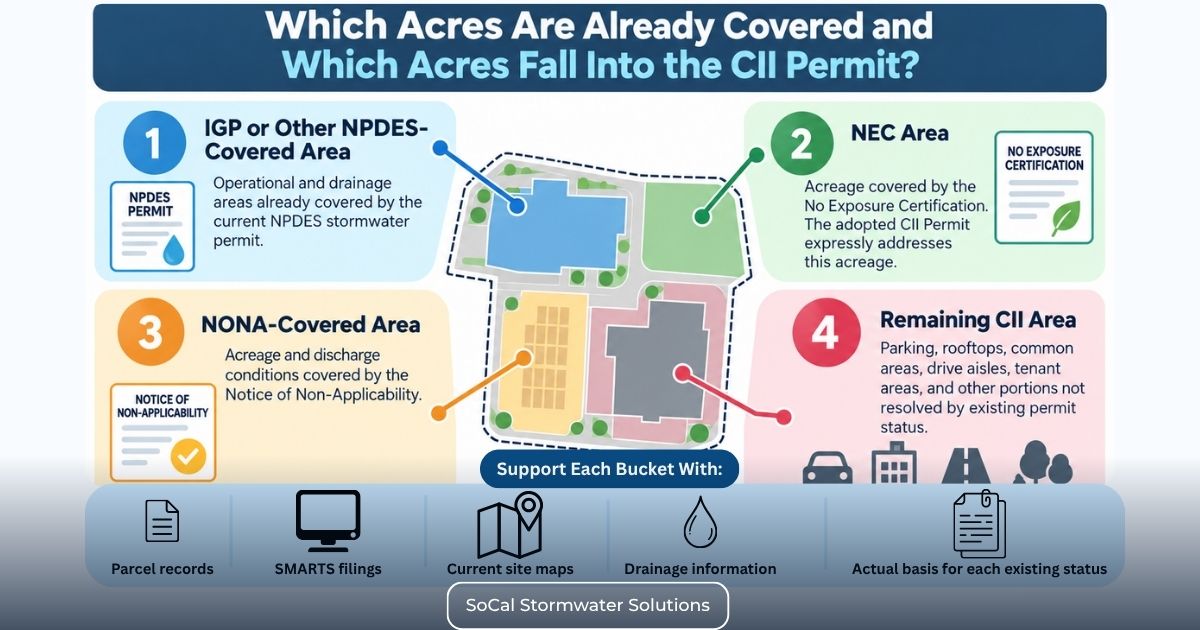
Bucket 1: IGP or Other NPDES-Covered Area: Identify operational and drainage areas actually covered by the current NPDES stormwater permit.
Bucket 2: NEC Area: Identify the acreage covered by the No Exposure Certification. The adopted CII Permit expressly addresses this acreage.
Bucket 3: NONA-Covered Area: Identify the acreage and site conditions supporting the Notice of Non-Applicability and distinguish that area from acreage outside the NONA.
Bucket 4: Remaining CII Area: Identify qualifying parking, rooftops, common areas, drive aisles, tenant areas, or other portions not resolved by the existing permit status.
The four buckets should be supported by parcel records, SMARTS filings, current site maps, drainage information, and the actual basis for each existing status.
For an existing IGP facility, relevant records may include the WDID, NOI, current Industrial SWPPP, site map, drainage map, facility boundary, industrial activity areas, and SMARTS records. Industrial SWPPP Services can support review of the existing plan and its documented coverage boundaries.
What happens if the facility has a No Exposure Certification?
A No Exposure Certification is not a blanket exemption from the Region 4 CII Permit.
Under the Industrial General Permit, an NEC provides a conditional exclusion for qualifying facilities that satisfy the IGP’s no-exposure requirements. The State Water Board’s Industrial General Permit materials maintain separate NEC instructions and SMARTS procedures for facilities using that status. 2 3
Section 3.1.3.1 of the adopted CII Permit states that facilities with an IGP NEC must obtain CII coverage for the acreage covered by the NEC when the CII Permit’s applicability requirements are met. 1
This distinction matters because the two programs ask different regulatory questions. An NEC addresses qualifying no-exposure conditions under the IGP. The CII Permit results from EPA’s residual designation of certain privately owned CII stormwater discharges within two specified watersheds.
A facility should therefore document:
- The acreage and activities covered by the NEC
- The parcel and total site area
- Whether the property meets the CII site definition
- Whether it is within one of the two covered watersheds
- Whether related parcels or areas fall outside the NEC footprint
- Whether the current site conditions still match the NEC records
The analysis should not state that the NEC is cancelled or invalidated by the CII Permit. The narrower conclusion is that NEC status does not, by itself, eliminate the separate CII coverage review.
What happens if the facility has a Notice of Non-Applicability?
The NONA rule uses a different acreage boundary from the NEC rule.
Section 3.1.3.2 states that an IGP facility with a Notice of Non-Applicability must obtain CII coverage for the acreage not covered by the NONA, subject to the CII Permit’s other applicability criteria. 1
The analysis must therefore establish what the NONA actually covers. A facility should retrieve the current SMARTS filing and supporting documentation rather than assume the status applies uniformly across every parcel or operational area.
Relevant questions include:
- Which parcel, discharge condition, or portion of the facility supports the NONA?
- What acreage is within the documented NONA boundary?
- Are there portions of the qualifying CII site outside that boundary?
- Do parking, rooftops, access areas, common areas, or drainage features fall outside the NONA basis?
- Has the facility layout or operating condition changed since the NONA was submitted?
The CII Permit does not state that every NONA facility automatically requires coverage for its entire parcel. It requires coverage for acreage not covered by the NONA when the remaining CII applicability requirements are satisfied.
Current State Water Board SMARTS resources provide separate guidance for industrial NONA preparation, change-of-information, recertification, and termination workflows. 3
What if only part of the property is covered by another stormwater permit?
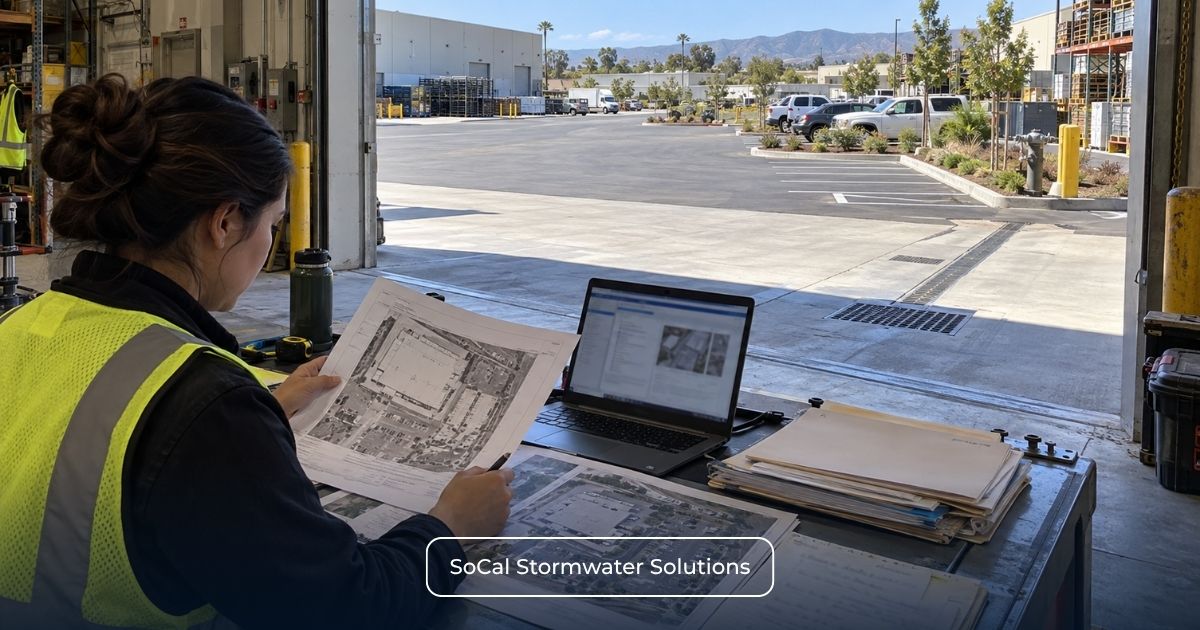
Section 3.1.3.3 directly addresses partial coverage. When another NPDES stormwater permit covers only a portion of a facility, the facility must obtain CII coverage for the remaining portion when the CII applicability criteria are met. 1
Consider a hypothetical warehouse property where facility records establish that another NPDES stormwater permit covers only part of the property. Assume, for this example, that the documented permit boundary includes the industrial operating area, outdoor material storage, and loading zone, while shared parking, roof-drainage areas, internal roads, and common areas fall outside that boundary. Those remaining areas would then need to be evaluated under the CII Permit’s applicability provisions.
The analysis should not assume that the existing WDID covers the entire property. It should compare:
- The full qualifying CII facility boundary
- The parcel and ownership configuration
- The areas shown in the existing Industrial SWPPP
- The drainage areas and discharge locations associated with the IGP
- The remaining portions outside that permit boundary
The hypothetical facility therefore requires evaluation of the remaining portion against the CII Permit’s applicability criteria; when those criteria are satisfied, Section 3.1.3.3 requires CII coverage for that remaining portion. 1 The conclusion depends on documented boundaries and the permit’s site, watershed, acreage, ownership, and existing-coverage provisions.
Responsibility may also be divided where a tenant holds the IGP while the property owner controls shared drainage or common areas. In that situation, the facility should separately resolve which party has the authority and operational control required to serve as the CII Discharger. The owner/operator determination should be based on the adopted permit rather than the name appearing on the existing IGP alone.
Can an individual NPDES Permit eliminate the need for CII coverage?
Yes, when the individual NPDES permit satisfies the CII Permit’s stringency condition.
Section 3.1.4 states that a facility with an individual NPDES permit containing requirements at least as stringent as those in the CII Permit is not required to obtain separate coverage under the CII General Permit. 1
The existence of an individual NPDES permit does not establish the exception by itself. The facility should review:
- The permit holder and regulated facility boundary
- Covered discharge types and locations
- Applicable pollutant controls
- SWPPP or equivalent planning requirements
- Monitoring and reporting requirements
- BMP and corrective-action obligations
- Whether the requirements are at least as stringent as the CII Permit
The stringency determination should be supported by the actual permit. A facility should not rely only on a permit number, summary page, or assumption that an individual permit is necessarily more comprehensive than a general permit.
How should an existing industrial facility check its CII Coverage now?

A practical, non-exclusive coverage review can begin with records rather than assumptions about the meaning of “IGP-covered,” “NEC,” or “NONA.” The following framework is intended for project review and is not a Water Board-prescribed applicability procedure.
- Retrieve current SMARTS and WDID records. Confirm the legal entity, facility, status, parcel information, and latest certified documents.
- Confirm the CII geography and site definition. Verify that the facility is a privately owned qualifying CII site within one of the two covered watershed areas.
- Map the total facility area. Preserve the total-area measurement used for the existing-NPDES threshold branch.
- Map each existing status. Identify the areas covered by the IGP or another NPDES permit, the NEC footprint, the NONA-covered area, and any individual-permit boundary.
- Identify remaining CII acreage. Compare the permit boundaries with parking, rooftops, common areas, drive aisles, tenant areas, and drainage features.
- Confirm the appropriate Discharger. Determine who has the authority and operational control to comply with the CII requirements for the relevant area.
- Document the applicability conclusion. Retain the maps, calculations, permit records, assumptions, and unresolved questions supporting the determination.
- Calendar applicable enrollment deadlines. Existing dischargers seeking coverage must submit a complete NOI and site-specific SWPPP within 12 months of the October 31, 2026 effective date, initial analytical results within 18 months, and Compliance Option Documents within three and one-half years. 1 For planning purposes, those intervals correspond to October 31, 2027; April 30, 2028; and April 30, 2030, respectively, based on the October 31, 2026 effective date. 1
These intervals apply to Existing Dischargers under Section 3.4.1. New Dischargers follow a different schedule: Section 3.4.2 requires the NOI, SWPPP, initial-sampling analytical results, and Compliance Option Documents at least 45 days before commencement of the authorized discharge.
Clarify Existing Coverage Before CII Enrollment
Existing IGP coverage, an NEC, a NONA, or another NPDES permit should be evaluated against the actual boundaries and applicability provisions of the Region 4 CII Permit. Mapping the existing regulatory status against the qualifying CII site can help identify which areas are already addressed and which portions require further CII coverage analysis.
Once coverage has been established, review Region 4 CII stormwater compliance costs when planning for permit fees, sampling, monitoring, and the applicable Compliance Option.
For related permitting assistance, see SMARTS Permitting and Application Services or contact SoCal Stormwater Solutions for an IGP/NEC/NONA-to-CII coverage review.