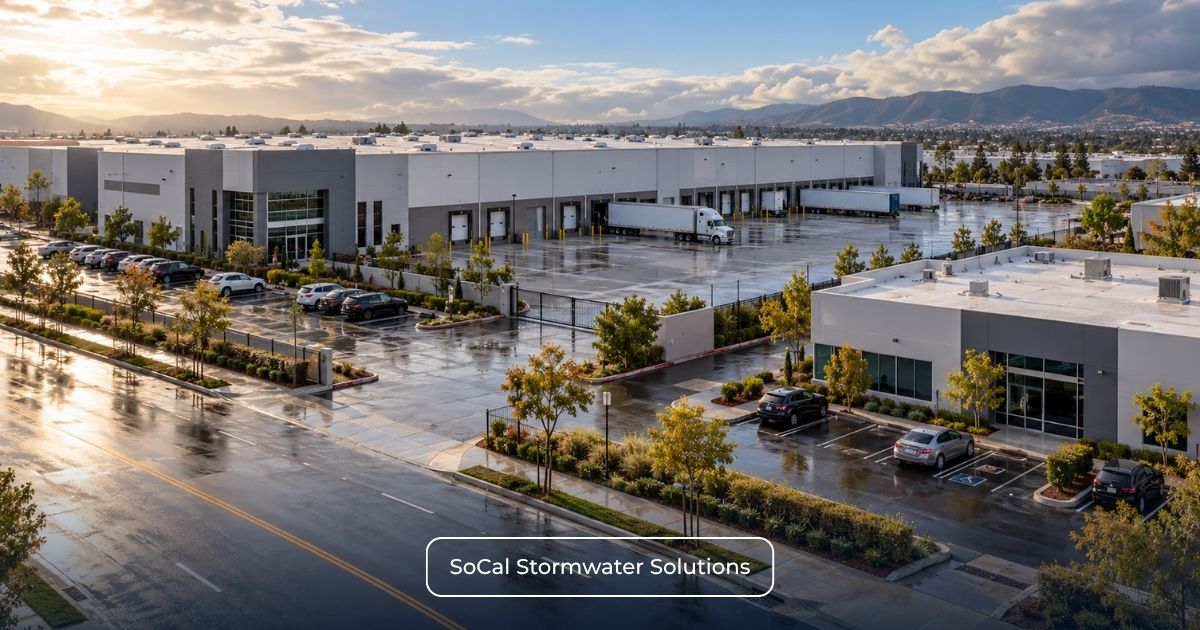
A facility can conduct most or all business activities indoors and still require evaluation under the Region 4 Commercial, Industrial, and Institutional Stormwater Permit. The permit addresses stormwater runoff from qualifying CII sites, including runoff from rooftops and other impervious surfaces associated with the property. It is not limited to sites where products or industrial materials are stored outdoors.
That does not mean every indoor warehouse, shopping center, office complex, institutional property, or manufacturing facility needs coverage. CII Permit indoor operations are only one part of the analysis. The property must satisfy the permit’s geographic, ownership, land-use, acreage, and existing-permit criteria before coverage applies.
| Indoor Operations Do Not Automatically Mean No CII Coverage |
| Coverage Test — Does the CII Permit Cover the Property? Review the watershed location, private ownership, facility type, applicable acreage threshold, existing NPDES status, parcel configuration, and any permit-specific exclusion.BMP Test — If Covered, What Controls Does the Site Need? Based on actual site conditions, evaluate outdoor pollutant exposure, roofs and paved areas, drainage and discharge points, loading and waste areas, vehicle or equipment activity, housekeeping, training, and other site-specific BMP considerations.Indoor operations may reduce some outdoor pollutant sources, but they do not independently determine whether the property requires CII Permit coverage. |

TL;DR
Indoor operations do not automatically exempt a qualifying property from the Region 4 CII Permit.
EPA’s final residual designation identifies rooftops, parking lots, sidewalks, and driveways as impervious surfaces that can generate stormwater runoff. 1
The CII Permit does not provide a general no-exposure exemption merely because materials, parking, or operational activities are under a roof.
Indoor storage and handling can reduce direct pollutant exposure and simplify BMP planning after coverage is established. They do not decide applicability by themselves.
A facility must still be screened for watershed location, CII classification, private ownership, acreage, existing NPDES status, and any applicable permit-specific exception.
Do indoor-only facilities still need the Region 4 CII Permit?
Yes, potentially. Conducting activities inside a building or storing products under a roof does not create a blanket exemption from Order R4-2026-0226.
The Los Angeles Regional Water Quality Control Board adopted the permit for qualifying privately owned CII sites in:
- The Dominguez Channel/Los Angeles and Long Beach Inner Harbor Watershed
- The Los Cerritos Channel/Alamitos Bay Watershed
The adopted permit is listed as active in the Water Board’s permit record but does not become effective until October 31, 2026. 2
A facility’s indoor status does not replace the normal coverage test. Applicability depends on the site’s location, property classification, private ownership, acreage, and existing NPDES stormwater coverage.
For qualifying CII sites not covered by another NPDES stormwater permit, the permit uses a threshold of five or more acres of impervious surface. Qualifying CII sites already covered by another NPDES stormwater permit are evaluated using five or more acres of total area. 3
Two indoor facilities should not be treated identically based only on the fact that their operations occur under a roof. Each property must be evaluated using the applicable acreage test together with its watershed location, CII classification, ownership, and existing NPDES permit status.
Why can a roofed facility still generate regulated stormwater runoff?
A roof keeps indoor materials and activities away from direct rainfall, but the roof itself is an impervious surface that receives and conveys precipitation. The adopted CII Permit defines impervious surface based on whether a surface prevents or significantly impedes infiltration and identifies rooftops, parking lots, walkways, patios, storage areas, roads, compacted surfaces, asphalt, and concrete among the surfaces that can qualify. 3 EPA’s residual-designation analysis separately discusses the high degree of impervious cover at CII sites and associated stormwater pollutant loading. 1
Runoff from these areas may encounter pollutants even when the primary business activity occurs indoors. EPA identifies several potential pathways:
- Tire and brake-pad wear deposited on parking and driving surfaces
- Motor oil, coolant, and other vehicle-fluid leaks
- Atmospheric deposition and wind-transported materials
- Pollutants accumulated on rooftops and other impervious surfaces 1
Other site-specific sources may include trash, outdoor cleaning residues, landscape materials, loading activities, equipment, exposed waste, or maintenance areas. These sources should be confirmed through a site review rather than assumed to exist at every facility.
A roofed property should therefore evaluate where rainfall lands, where runoff travels, which surfaces it contacts, and where it leaves the site. The fact that products remain indoors does not answer those drainage questions.
Does “No Exposure” under the Industrial General Permit solve the CII question?
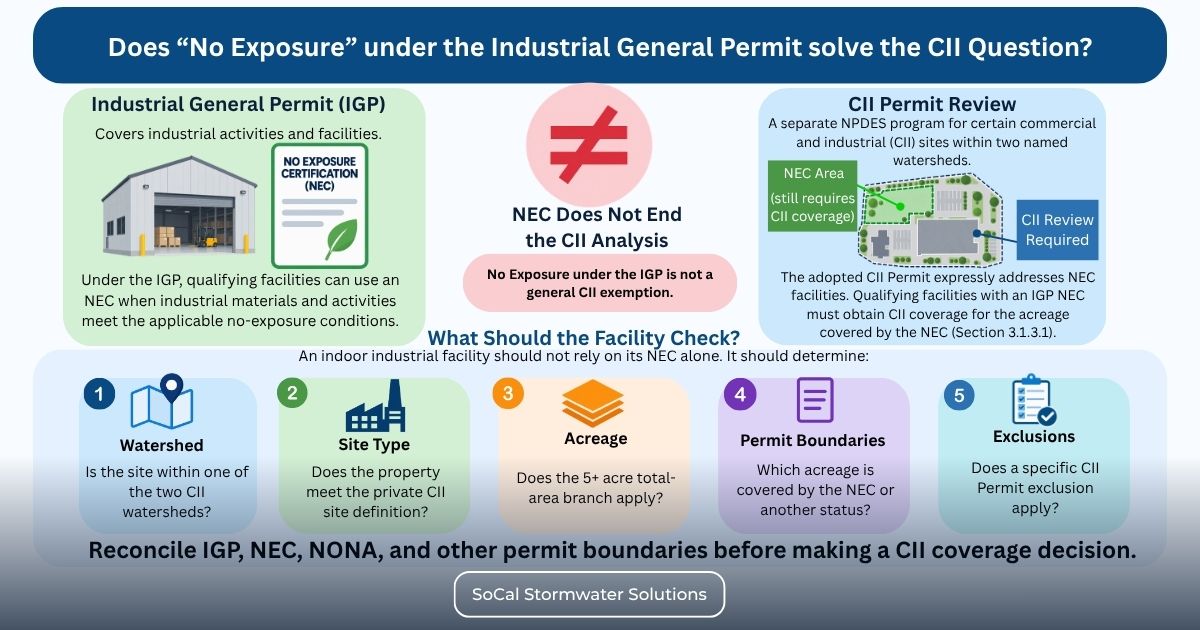
No. A No Exposure Certification is part of the Industrial General Permit framework. It should not be extended into a general CII no-exposure exemption.
Under the IGP, qualifying facilities can use an NEC when industrial materials and activities satisfy the applicable no-exposure conditions. The CII program is a separate NPDES program arising from EPA’s residual designation of stormwater discharges from certain CII sites within the two named watersheds.
The adopted CII Permit expressly addresses NEC facilities. Section 3.1.3.1 states that qualifying facilities with an IGP NEC must obtain CII coverage for the acreage covered by the NEC. 3
This means an indoor industrial facility should not rely on its NEC alone to end the CII analysis. As practical, non-exclusive screening considerations, the facility can evaluate:
- Whether it is within one of the two CII watersheds
- Whether it meets the permit’s private CII site definition
- Whether the five-or-more-acres total-area branch applies
- Which acreage is covered by the NEC
- Whether other portions of the property have different permit status
- Whether an exact permit exclusion applies
Facilities comparing their current Industrial SWPPP or no-exposure status with the new CII requirements can review Industrial SWPPP Services. Existing IGP, NEC, NONA, and partial-coverage status can be compared with the CII Permit’s applicable site and acreage provisions when evaluating coverage.
What did the Water Board say about indoor shopping centers and covered parking?
During the permit-development process, commenters asked the Los Angeles Water Board to apply NEC-style treatment to commercial and institutional facilities where activities occur under a roof. Their examples included indoor shopping centers and covered parking lots.
In its response to Comment 18.3, the Water Board did not adopt that requested approach. It explained that even where parking is covered or activities occur under a rooftop, runoff from the site’s impervious surfaces, including rooftops and storm-resistant shelters, can still contribute pollution to impaired water bodies. The response states that NEC or NONA is not an option under the CII Permit. 4
This response addresses the no-exposure argument. It does not establish that every indoor shopping center or covered parking facility is automatically covered.
A property still needs to satisfy the adopted permit’s applicability requirements. An indoor shopping center outside the two watersheds, below the applicable acreage threshold, outside the qualifying land-use scope, or covered by a valid permit-specific exception would not become subject to this CII Permit merely because it has a roof or parking area.
The correct conclusion is narrower: covered parking and roofed activities do not, by themselves, create a CII exemption.
How can indoor operations affect CII compliance planning?
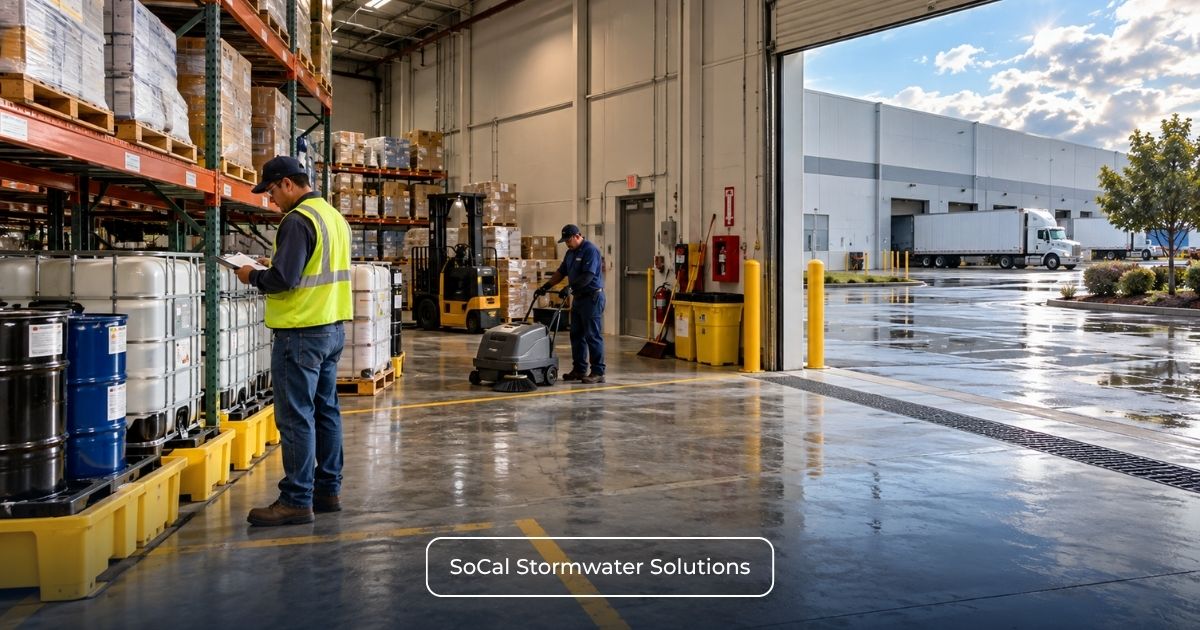
Indoor operations can still provide meaningful source-control benefits. Keeping pollutant-generating materials and activities away from rainfall can reduce direct exposure and make the facility’s runoff-control program more focused.
Section 6.5 establishes minimum BMP requirements that include Good Housekeeping, Exposure Minimization, and an Employee Training Program. These requirements address site-specific pollutant sources and include measures related to materials, spills and leaks, pollutant accumulation, waste, and erosion and sediment discharges. 3
For a covered facility, indoor storage or handling may:
- Reduce the number of exposed pollutant sources
- Limit the outdoor areas requiring source controls
- Simplify inspection priorities
- Reduce the likelihood of materials being mobilized by runoff
- Make housekeeping and employee responsibilities easier to define
- Support a more targeted site map and SWPPP
- Reduce the need for certain exposure-related corrective actions
These potential benefits depend on actual site conditions. An indoor operation with extensive vehicle activity, roof runoff, uncovered loading, outdoor waste areas, or complex drainage may still require substantial controls. Conversely, a site with limited outdoor sources and well-managed runoff pathways may have a simpler BMP program.
Lower outdoor-source complexity can affect compliance planning and practical cost. It does not automatically change the initial coverage determination or make a particular compliance option available.
Once coverage is established, see How Much Will the Region 4 CII Stormwater Permit Cost? Fees, Sampling, and Compliance Options for separate budgeting guidance.
For related field and monitoring services, see Industrial Inspections and Monitoring.
What could still keep an indoor facility outside this CII Permit?
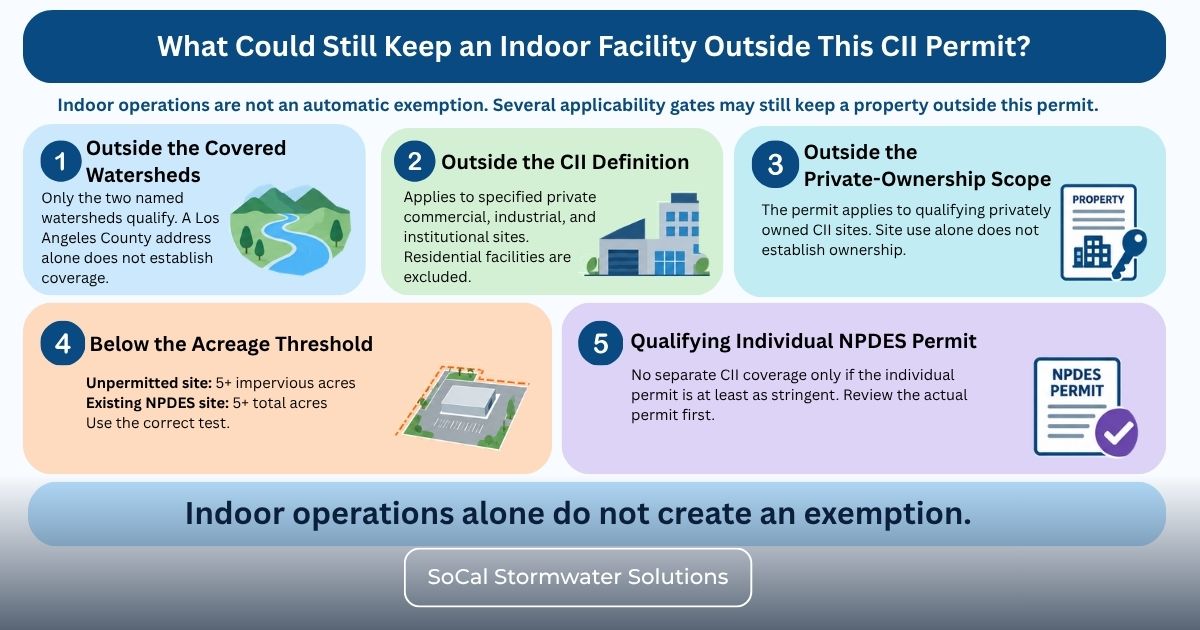
Indoor operations are not an automatic exemption, but several actual applicability gates can keep a property outside this specific permit.
Location Outside the Covered Watersheds
The Region 4 CII Permit applies only within the Dominguez Channel/Los Angeles and Long Beach Inner Harbor Watershed and the Los Cerritos Channel/Alamitos Bay Watershed. A Los Angeles County address alone does not establish coverage. 3
Property Outside the CII Definition
The permit applies to certain privately owned commercial, industrial, and institutional sites based on specified Los Angeles County Assessor land-use codes. Residential facilities are excluded. 3
Property Outside the Private-Ownership Scope
The permit applies to qualifying privately owned CII sites. Ownership therefore remains a separate applicability consideration and should not be inferred solely from the facility’s commercial, industrial, or institutional use. 3
Property Below the Applicable Acreage Threshold
A qualifying CII site not covered by another NPDES stormwater permit uses the five-or-more-impervious-acres test. A qualifying site covered by another NPDES stormwater permit uses the five-or-more-acres total-area test. 3
Total parcel acreage should not replace impervious acreage for a qualifying CII site not covered by another NPDES stormwater permit. Similarly, impervious acreage should not replace total area where the existing-NPDES-coverage branch applies.
For the complete acreage analysis, see Region 4 CII Permit 5-Acre Threshold: Does Your Property Need Coverage?
Qualifying Individual NPDES Permit
A facility with an individual NPDES permit containing requirements at least as stringent as those in the CII Permit is not required to obtain separate coverage under this General Permit. 3
The facility must review the actual individual permit before relying on this exception. The existence of an individual permit alone does not prove that its requirements are sufficiently stringent.
How should an indoor facility check CII applicability?
As a practical, non-exclusive screening framework, not a Water Board-prescribed applicability procedure, an indoor facility can evaluate the following factors before concluding that a low-exposure profile eliminates CII obligations:
- Confirm the property address and watershed. Determine whether the site falls within either covered watershed area.
- Verify the land use and ownership. Confirm that the property meets the adopted definition of a privately owned CII site. Where indoor tenant operations and property-owner control of common areas or drainage are split, see Region 4 CII Permit: Is the Property Owner or Tenant Responsible for Compliance?
- Document total and impervious acreage. Identify rooftops, parking areas, sidewalks, driveways, roads, and other surfaces that meet the permit’s impervious-surface definition, accounting for any surfaces the permit excludes from that definition. 3
- Review current permit status. Retrieve any IGP, NEC, NONA, individual NPDES, or partial-coverage records.
- Map roof, parking, and drainage conditions. Identify roof drains, surface-flow routes, catch basins, discharge points, shared drainage, and receiving-water information.
- Identify outdoor pollutant sources. Review loading, vehicles, waste, equipment, maintenance, cleaning, landscaping, and storage conditions.
- Check exact permit exclusions. Do not rely on indoor operations or general no-exposure assumptions as substitutes for the adopted permit language.
- Separate coverage from BMP design. First determine whether the site requires coverage. Then develop controls proportionate to its actual exposure and runoff pathways.
Clarify CII Applicability for an Indoor Facility
Indoor operations can affect pollutant exposure, but they do not replace the permit’s site, watershed, ownership, acreage, and existing-coverage criteria. A coverage determination should therefore distinguish the regulatory applicability question from the BMP and exposure conditions that matter after coverage applies.
For project-specific assistance related to Region 4 CII Permit compliance, contact SoCal Stormwater Solutions. For related permitting information, see SMARTS Permitting and Application Services.