A Notice of Non-Applicability (NONA) under California’s Industrial General Permit does not automatically exempt an entire property from the Region 4 Commercial, Industrial, and Institutional (CII) Stormwater Permit. Section 3.1.3.2 of Order R4-2026-0226 directs qualifying facilities to obtain CII Permit coverage for the acreage not covered by the NONA. The practical question is therefore not simply whether a facility has a NONA, but what portion of the qualifying CII site is actually addressed by that NONA. 1
Order R4-2026-0226 became effective on October 31, 2026. It applies only within the Dominguez Channel/Los Angeles and Long Beach Inner Harbor Watershed and the Los Cerritos Channel/Alamitos Bay Watershed. 2

TL;DR
- A NONA does not create a blanket property-wide exemption from the Region 4 CII Permit.
- Section 3.1.3.2 directs qualifying NONA facilities to obtain CII coverage for acreage not covered by the NONA.
- The facility must compare the full qualifying CII site with the acreage and conditions actually addressed by its NONA documentation.
- The actual NONA reason, facility information, and supporting records should be verified in SMARTS. Not every NONA is based on a no-discharge determination.
- The property must still satisfy the CII Permit’s other applicability requirements, including private ownership, qualifying CII use, covered watershed location, and the applicable acreage threshold.
- Review the NONA and CII requirements together before terminating, modifying, or replacing an existing stormwater status.
Does a NONA exempt a facility from the Region 4 CII Permit?

No blanket exemption exists. The CII Permit specifically addresses facilities that have submitted a NONA under the Industrial General Permit, or IGP. Under Section 3.1.3, qualifying sites within this existing-status branch are evaluated using a threshold of five or more acres of total area. Section 3.1.3.2 then states that facilities with a submitted NONA must obtain coverage under the CII Permit for acreage not covered by the NONA. 1
This rule does not mean that every property associated with a NONA automatically needs CII coverage. Before applying Section 3.1.3.2, the review must establish that the relevant property is:
- A qualifying commercial, industrial, or institutional site;
- Privately owned;
- Within one of the two regulated watershed areas;
- Subject to the applicable five-or-more-acres-of-total-area provision; and
- Not otherwise excluded under the permit’s coverage provisions.
The five-acre threshold is therefore one part of the analysis, not a complete coverage determination.
For the full acreage methodology, see California CII Permit 5-Acre Rule Explained.
What does a NONA mean under California’s Industrial General Permit?
A NONA is a Notice of Non-Applicability. It is used to document that Industrial General Permit coverage is not applicable based on the reason identified in the facility’s submission. A submitted NONA records the facility’s claimed basis for non-applicability; its existence alone does not establish that the stated basis remains accurate under current operating and drainage conditions. A NONA is not an NPDES permit and should not be described as a “NONA permit” or as ordinary IGP coverage.
Although Order 2014-0057-DWQ reached its original expiration date, the State Water Board states that the Industrial General Permit remains administratively continued until a new permit is issued. 3
The actual reason for the NONA matters. The IGP Fact Sheet explains that NONAs can reflect multiple circumstances, including facility closure, not being the legal owner, an incorrect SIC code, eligibility for the No Exposure conditional exclusion, or no discharge to waters of the United States. A reviewer should not assume that every NONA rests on the same technical basis. 4
The appropriate starting point is to retrieve the current SMARTS record, identify the selected NONA reason, and review the facility information and supporting documents. SoCal Stormwater Solutions’ Industrial Stormwater Permitting Process services can support the review of existing IGP records and coordination of the appropriate permit pathway.
Which acreage does the CII permit apply to at a NONA facility?
For a facility that otherwise meets the requirements of Section 3.1.3, the permit focuses on acreage not covered by the NONA. Determining that acreage requires more than finding a NONA identification number in SMARTS. The submitted facility information, site limits, maps, technical documentation, and current physical conditions must be compared with the full qualifying CII site.
NONA and No Exposure Certification (NEC) status receive different treatment under the CII Permit, as summarized below. The review questions are practical screening prompts, not additional Water Board requirements.
NONA vs NEC Under the Region 4 CII Permit |
|||
|---|---|---|---|
| Existing IGP Status | Meaning Under the IGP | CII Permit Treatment | Primary Review Question |
| NONA | Notice of Non-Applicability | Section 3.1.3.2 Directs Qualifying Facilities to Obtain CII Coverage for Acreage Not Covered by the NONA | What acreage and conditions are actually addressed by the NONA? |
| NEC | No Exposure Certification | Section 3.1.3.1 Directs Qualifying Facilities to Obtain CII Coverage for Acreage Covered by the NEC | What acreage is included under the NEC? |
This comparison does not replace a facility-specific applicability review. It shows why a NONA record cannot be evaluated as though it were an NEC or an active IGP permit.
How do you compare the NONA with the full CII site?
A practical review may compare the qualifying CII site with the facility information and supporting documentation associated with the NONA. However, not every NONA establishes a separately mapped or independently defined acreage boundary. The review must first identify the reason for the NONA and determine what the submitted records actually establish. Any comparison of site areas is an interpretive screening method, not a boundary-reconciliation procedure prescribed by the Water Board.
The review should bring together:
- The current SMARTS NONA record, identification number, selected reason, and facility information;
- Supporting maps, technical documentation, and current parcel/site boundaries;
- Total site acreage and relevant roof, parking, operational, tenant, and common areas;
- Current drainage areas and discharge points;
- Any other NPDES stormwater coverage; and
- The facility’s current physical and operational configuration.
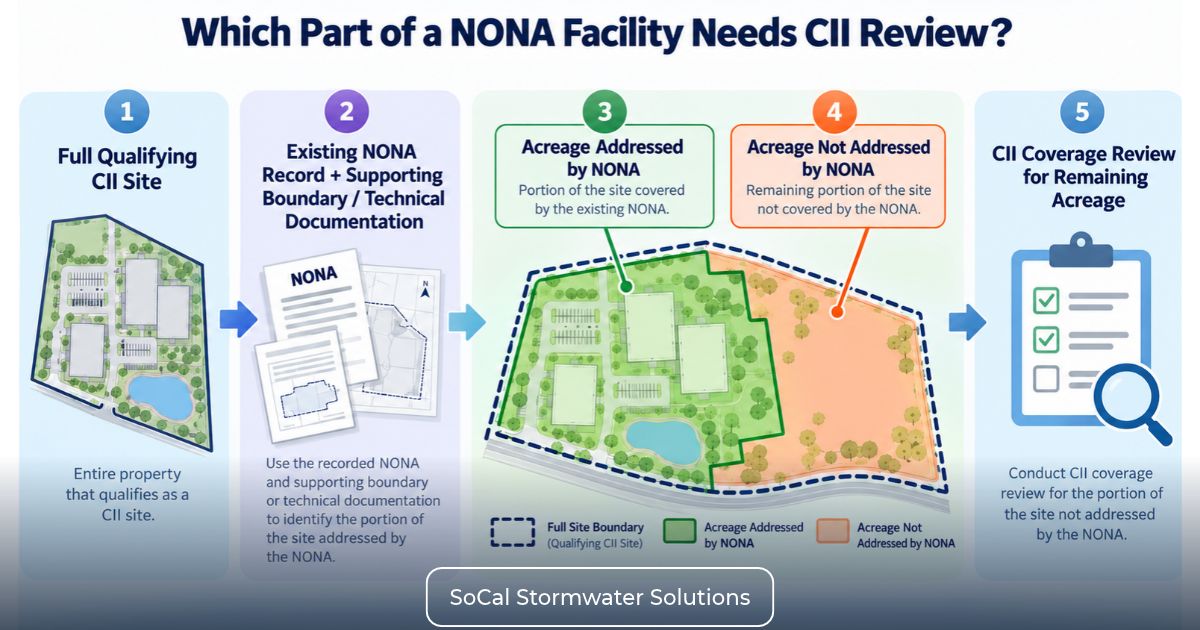
Illustrative Boundary-Reconciliation Example
For illustration only, assume the supporting documentation for a no-discharge NONA expressly identifies a five-acre facility area within a larger eight-acre property. This is a hypothetical documentation scenario, not an assumption that all NONAs establish separately covered acreage.
Consider a privately owned industrial property within a covered watershed that contains eight acres in total. Its existing no-discharge NONA documentation addresses a five-acre operational and containment area. The current property also includes a separate parking area, shared driveway, roof drainage, or tenant-controlled area that is not shown within the documentation supporting the NONA.
This example does not automatically establish that the remaining three acres require CII coverage. It shows the required analytical sequence: confirm the full qualifying CII site, verify the actual NONA scope, identify any acreage outside it, and then apply the remaining CII applicability provisions to that acreage.
Conversely, if the submitted NONA and its supporting documentation demonstrably correspond to the entire qualifying CII site, Section 3.1.3.2 does not itself identify remaining “acreage not covered by the NONA.” That conclusion should be made only after confirming that the NONA remains current and that its documented facility scope matches the present CII site.
SoCal Stormwater Solutions’ SMARTS Permitting and Application Services can assist with reviewing the SMARTS record and organizing documentation for any subsequent CII registration workflow.
What if the NONA is based on “No Discharge”?
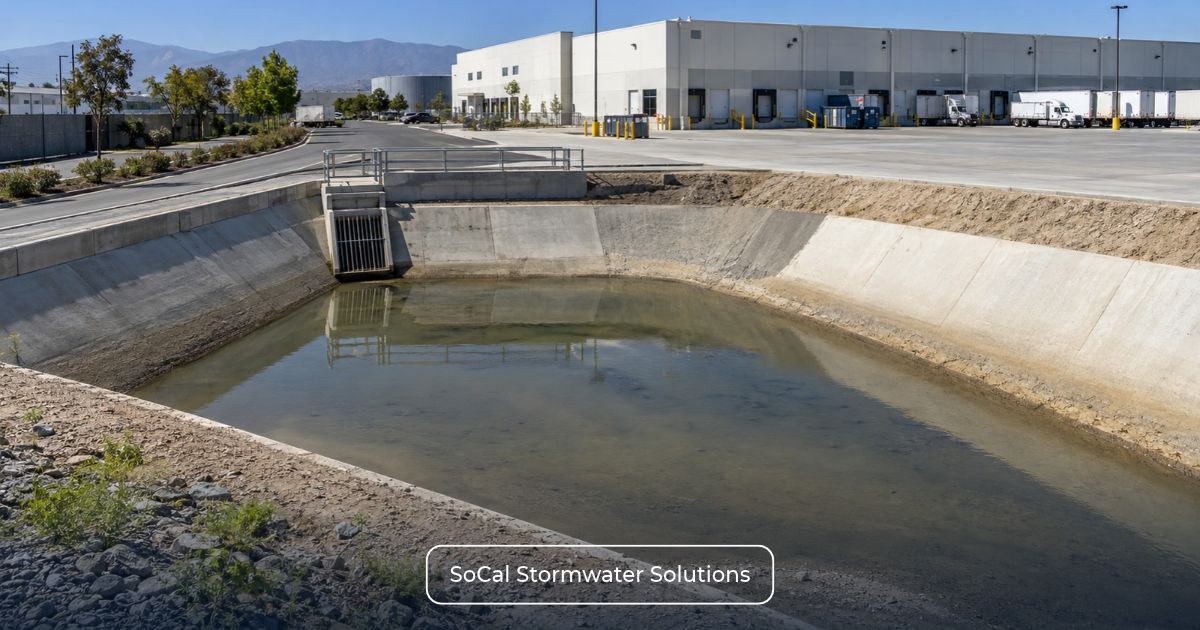
A no-discharge NONA has a specific technical basis. The State Water Board’s current NONA guidance identifies two eligibility paths:
- The facility is engineered and constructed to contain the maximum historic precipitation event or series of events so that industrial stormwater will not discharge to waters of the United States; or
- The facility is located in a basin or other physical location that is not hydrologically connected to waters of the United States.
When the no-discharge option is used, a No Discharge Technical Report must be submitted with the NONA through SMARTS. The report must be developed, signed, and stamped by a California-licensed professional engineer and must demonstrate that the applicable eligibility requirements are met. 5
These technical-report requirements should not be applied automatically to a NONA filed for another reason. The SMARTS record must first be checked to determine why the NONA was submitted.
For a no-discharge NONA, the CII review should examine whether the report’s described containment system, drainage setting, facility area, and assumptions correspond to the current qualifying CII site. It should not assume that a technical conclusion prepared for one defined industrial area necessarily addresses every parcel, tenant space, roof, parking area, or drainage path on the broader property.
What if the site has changed since the NONA was filed?
A historic NONA record may not accurately represent current site conditions. Changes do not necessarily invalidate the NONA automatically, but they should trigger a review of its status, technical basis, and physical scope.
Relevant changes can include:
- New buildings, pavement, or changes to the facility or parcel boundary;
- New tenants, operational areas, or changes in ownership or facility information;
- Altered grading, drainage patterns, or discharge points;
- Modified berms, containment, infiltration, or other drainage controls;
- Changes in material handling or industrial activities; and
- Changes affecting the scope of another NPDES stormwater permit.
The review should compare the current property with the conditions documented when the NONA was submitted. Where the record and present site no longer align, the appropriate administrative path should be determined before changing the NONA or preparing CII enrollment documents.
What should a NONA facility review before CII enrollment?
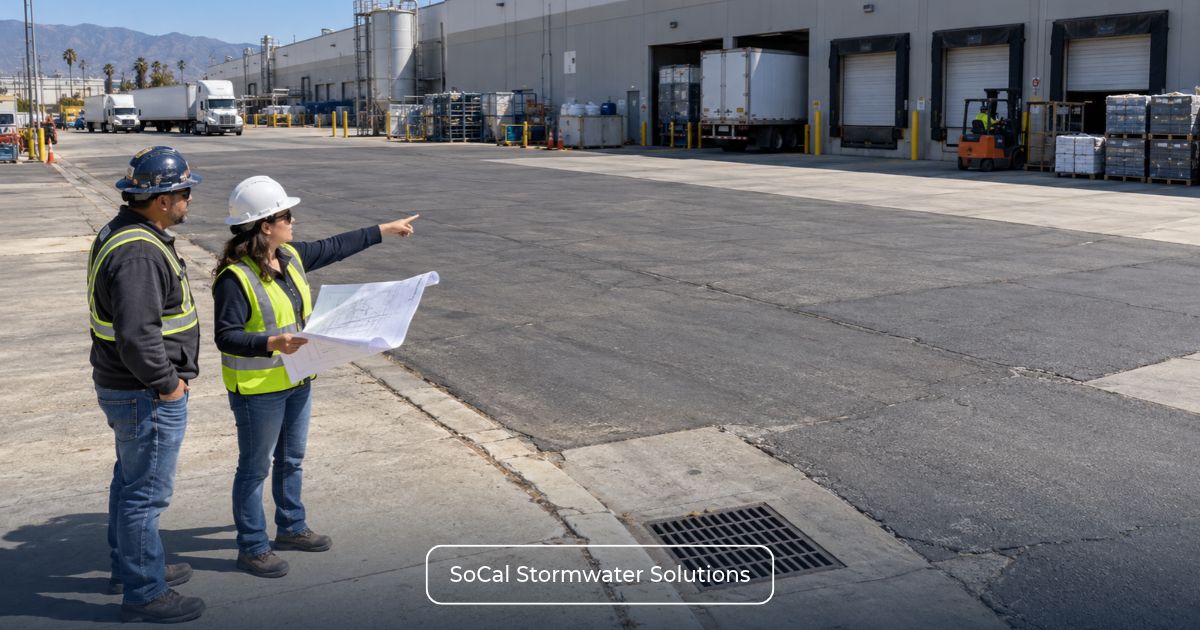
Before beginning CII registration, a facility should assemble enough information to establish both sides of the boundary comparison: the complete qualifying CII site and the area actually addressed by the NONA.
CII/NONA Coverage Review Checklist
Before CII enrollment, confirm:
- The current NONA ID, SMARTS record, and selected NONA reason;
- Facility and parcel boundaries, APNs, and total acreage;
- The No Discharge Technical Report and supporting maps, if applicable;
- CII land-use classification, private ownership, and covered-watershed location;
- Current drainage areas, discharge points, and other NPDES stormwater coverage;
- What area or conditions the NONA documentation actually addresses;
- Any portion of the qualifying CII site outside that documented scope; and
- Material physical, operational, ownership, or administrative changes since the NONA was submitted.
The recommended sequence is review first, then file. A facility should not be instructed to cancel, terminate, replace, or modify its existing NONA until the current IGP status and CII applicability have been evaluated together.
If the review determines that CII enrollment is required, the next phase may include preparation of a site-specific SWPPP and applicable Permit Registration Documents. Industrial SWPPP Services can support that later documentation stage without implying that every NONA facility automatically requires an Industrial SWPPP.
To begin a site-specific review, provide the current NONA record, facility address, parcel and site maps, acreage information, drainage documentation, and supporting technical report where applicable.
For questions about stormwater permitting and compliance services relevant to your facility, contact SoCal Stormwater Solutions to discuss the applicable scope of support.