When another NPDES stormwater permit covers only part of a qualifying Commercial, Industrial, and Institutional (CII) facility, Section 3.1.3.3 of Order R4-2026-0226 requires CII Permit coverage for the remaining portion of the facility. This rule applies only after confirming that the relevant site meets the permit’s CII-site, private-ownership, watershed, and five-or-more-acres-of-total-area requirements. The remaining portion does not have to pass a separate five-acre test. 1 4
Order R4-2026-0226 / NPDES Permit CAS004005 became effective on October 31, 2026. It applies within the Dominguez Channel/Los Angeles and Long Beach Inner Harbor Watershed and the Los Cerritos Channel/Alamitos Bay Watershed, not throughout Los Angeles County generally. 2

TL;DR
- An existing NPDES stormwater permit does not automatically establish coverage for an entire property.
- Section 3.1.3 evaluates qualifying CII sites covered by another NPDES stormwater permit using five or more acres of total area.
- Section 3.1.3.3 requires CII coverage for the remaining portion when the other NPDES stormwater permit covers only part of the facility.
- The remaining portion does not independently need to be five acres. The five-acre total-area test applies at the qualifying CII-site level.
- A WDID, permit number, or Industrial SWPPP title does not prove whole-property coverage. The actual coverage boundary must be established from current permit, SMARTS, SWPPP, mapping, operational, and drainage records.
- Areas outside an existing permit are not automatically subject to the CII Permit. The remaining area must still fall within the qualifying CII site and applicable geographic and ownership framework.
What does the CII permit require when only part of a property has NPDES coverage?

Section 3.1.3.3 addresses facilities where another NPDES stormwater permit covers only a portion of the facility. For qualifying sites, the CII Permit requires coverage for the remaining portion. 1
The provision should not be interpreted in isolation. The broader Section 3.1.3 applicability branch concerns CII sites that:
- Are covered by another NPDES stormwater permit;
- Have five or more acres of total area;
- Meet the permit’s CII-site requirements;
- Are privately owned;
- Are located within one of the two covered watershed areas; and
- Are not removed from coverage by another applicable provision.
Only after those conditions are evaluated should the property be divided into the portion covered by the existing NPDES stormwater permit and the remaining portion addressed by Section 3.1.3.3.
Where is the CII coverage gap?
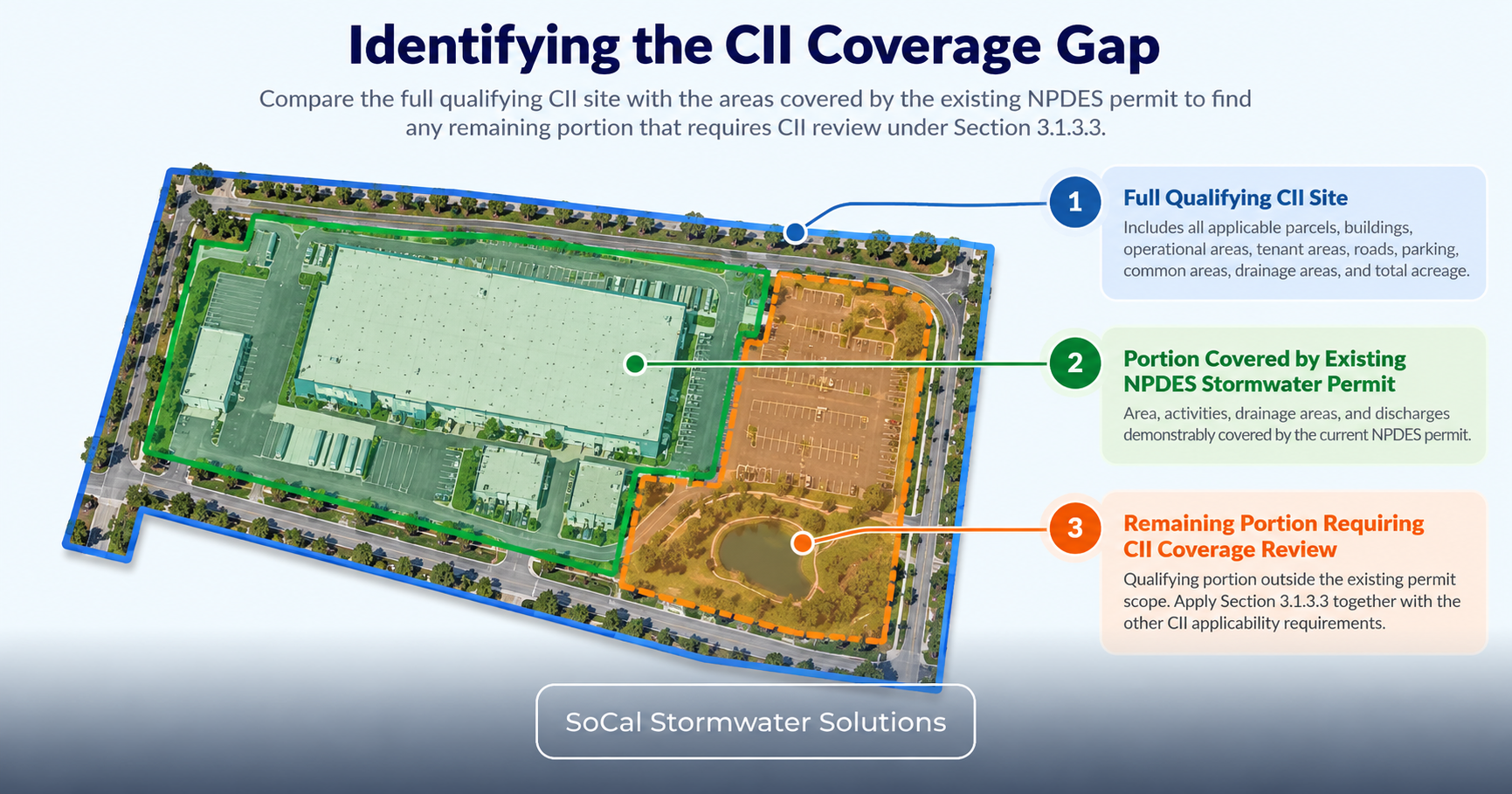
The coverage gap cannot be identified from a WDID or permit number alone. The full qualifying CII site must first be compared with the physical areas, activities, drainage areas, and discharges demonstrably covered by the existing NPDES stormwater permit. The visual below separates those two layers and identifies the remaining portion that requires review under Section 3.1.3.3.
Does the remaining portion have to be five acres?
The adopted Order does not establish a separate five-acre threshold for the remaining portion. 4
Section 3.1.3 first establishes the gateway: a qualifying CII site covered by another NPDES stormwater permit must have five or more acres of total area. Section 3.1.3.3 then addresses the situation in which that other permit covers only part of the facility and directs CII coverage to the remaining portion. 1
The sequence is therefore:
- Identify the full qualifying CII site.
- Confirm that the site enters the Section 3.1.3 total-area branch.
- Establish what portion another NPDES stormwater permit covers.
- Identify the remaining portion.
- Apply the Section 3.1.3.3 coverage requirement to that portion.
The correct threshold is not five acres of uncovered area. A six-acre qualifying CII site, for example, could enter Section 3.1.3 even if another permit covers four acres and two acres remain. This does not mean the two acres automatically qualify merely because they are outside the existing permit; they must still be part of the qualifying CII site and within the applicable ownership and geographic scope.
Detailed acreage measurement and parcel-configuration methodology belongs in “Region 4 CII Permit 5-Acre Threshold: Does Your Property Need Coverage?”
How do you determine what the existing NPDES permit actually covers?

An existing WDID or permit number confirms an administrative record, but it does not independently establish that the entire property is covered. The actual permit scope must be reconstructed from controlling documents and current site conditions.
The review should examine:
- The current NOI or individual NPDES permit, WDID, and SMARTS record;
- The current Industrial SWPPP and facility/site maps, if applicable;
- Drainage areas, flow directions, discharge and sampling locations;
- Industrial activity, material-handling, parcel, and campus boundaries;
- Any NEC or NONA affecting specific acreage; and
- Permit amendments and material changes in operations, drainage, ownership, or site configuration.
California’s Industrial General Permit, Order 2014-0057-DWQ as amended, remains administratively continued until a replacement permit is issued. Its existing records and requirements should therefore be preserved while the CII boundary analysis is completed. 3
“Permit footprint” and “coverage footprint” can be useful shorthand for the physical area, activities, drainage areas, and discharges addressed by the existing permit. Neither is a defined term in the CII Order, and neither should replace the controlling permit documents.
A historic map may also be insufficient if buildings, pavement, drainage paths, operational areas, or property boundaries have changed. Current conditions should be compared with the administrative record rather than assuming the older configuration remains accurate.
Reviewing the existing permit record is an important step before determining whether a separate CII coverage obligation applies. The Industrial Stormwater Permitting Process provides related service information, while the specific scope of any permit-record review should be confirmed for the facility.
What counts as the “Remaining Portion” of the facility?
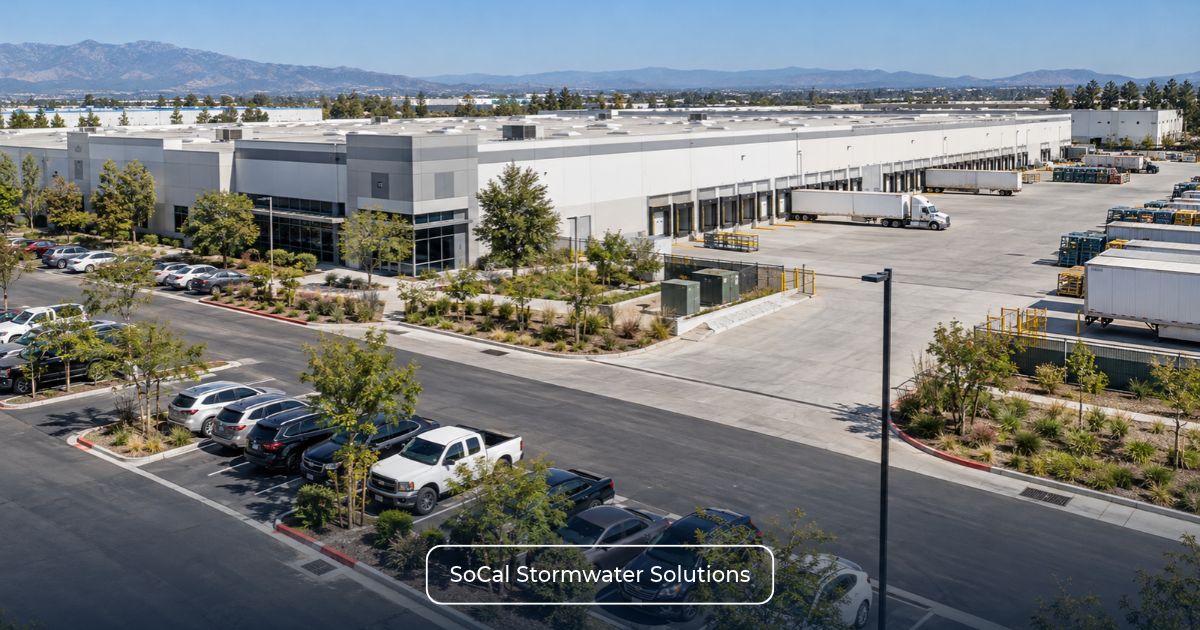
For purposes of Section 3.1.3.3, the remaining portion is the part of an otherwise qualifying CII site that is not covered by the other NPDES stormwater permit. Identifying that portion requires an assessment of the existing permit’s scope and the applicable CII site boundary. An area should not be classified as uncovered solely because it is absent from a particular SWPPP map or is used for non-industrial activities.
Depending on the actual permit and site configuration, the remaining portion could include:
- Roofs and roof-drainage areas;
- Parking, internal roads, and drive aisles;
- Common loading, access, or landscaped areas;
- Tenant-controlled or other non-industrial areas; and
- Other drainage areas or discharge points outside the existing permit scope.
These areas are not automatically outside an Industrial General Permit or other NPDES permit. A roof, parking lot, or shared road may drain through the same regulated drainage area as an existing industrial operation, or the applicable permit documents may already address it. Conversely, an area located on the same parcel may remain outside the documented permit scope.
The required comparison is summarized below.
Full Site vs Existing Permit vs Remaining Portion |
||
|---|---|---|
| Full Qualifying CII Site | Existing NPDES-Covered Portion | Remaining Portion for CII Coverage |
| Establishes the Overall Site Subject to the Section 3.1.3 Applicability Screen | Identifies the Area, Activities, Drainage Areas, and Discharges Already Covered by Another NPDES Stormwater Permit | Identifies the Portion Addressed by Section 3.1.3.3 After the Other CII Requirements Are Satisfied |
| Supported by the Parcel or Site Map, CII Classification, Private Ownership, Covered Watershed Location, and Total Acreage | Supported by the NOI or Permit, WDID and SMARTS Record, SWPPP, Facility Map, and Drainage/Discharge Documentation | Supported by the Boundary Comparison and Current Operational and Drainage Review |
The table does not label the third area as automatically covered. It identifies the portion for which the CII coverage obligation must be established under the complete applicability framework.
Where the permit documents do not fully reflect current site conditions, drainage areas, discharge points, operational boundaries, and BMP locations may need closer examination. Industrial Inspections and Monitoring provides information about related field services. Whether those services include the specific boundary or coverage assessment needed for a particular facility should be confirmed before proceeding.
Example: Industrial Operations Covered, Common Property Areas Outside the Permit
Consider a seven-acre manufacturing or warehouse property within a covered watershed. Its Industrial SWPPP documents the operational yard, material-handling areas, associated drainage, and discharge points, while the larger property also contains a roof, parking, shared drive aisles, landscaped areas, and tenant or common space.
If the existing records do not clearly establish whether those additional areas fall within the NPDES permit scope, the review should compare:
- the full qualifying CII site;
- the areas demonstrably covered by the existing permit; and
- any remaining portion shown to fall outside that coverage while still remaining within the qualifying CII site.
Section 3.1.3.3 then applies to that remaining portion after the other CII applicability requirements are confirmed. This is an illustrative review method, not a Water Board-prescribed mapping procedure, and does not mean that roofs, parking, landscaping, or tenant areas are automatically outside an IGP.
Where both programs apply, existing and new stormwater documentation should be reviewed together to identify overlapping requirements and any differences in permit scope. The facility’s existing Industrial SWPPP, drainage maps, and BMP documentation may provide useful context for this comparison. Industrial SWPPP Services is a related resource, although any CII-specific document preparation or coordination should be confirmed as part of the proposed service scope.
How do multi-tenant or shared properties affect partial coverage?
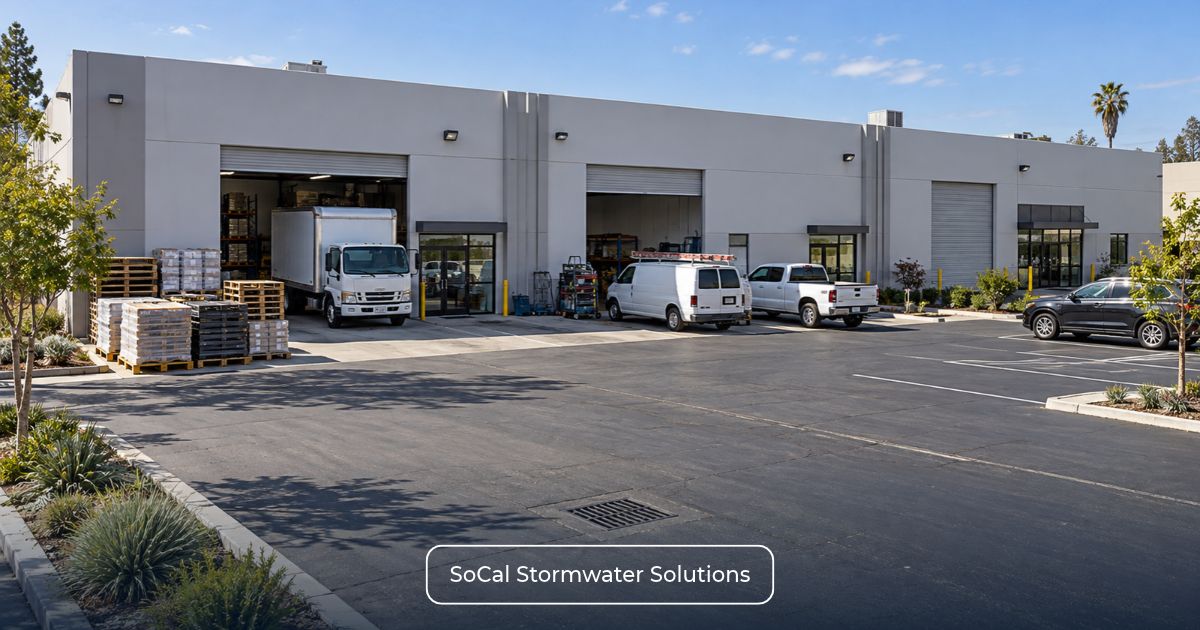
Partial coverage becomes more complex when different parties control different areas of the property. An industrial tenant may hold the existing WDID and control its operational yard, while the property owner or another tenant controls the roof, parking, shared roads, landscaped areas, storm drains, or common discharge points.
A reliable review should compare:
- Parcel ownership and lease/operational-control boundaries;
- The entity named in the existing permit and areas managed by each tenant;
- Common-area maintenance and storm-drain responsibilities;
- The physical drainage configuration; and
- The CII Permit’s owner, operator, and Discharger provisions.
The presence of separate leases does not necessarily mean the drainage system or applicable site boundary is physically divided in the same way. Likewise, shared ownership does not prove that one existing permit covers all tenants and common areas.
This article does not assign responsibility categorically. That analysis belongs in “Region 4 CII Permit: Is the Property Owner or Tenant Responsible for Compliance?” The permit boundary, property-control structure, and responsibility question should be reviewed together before an owner or tenant is instructed to enroll.
NEC and NONA acreage must also remain separate from ordinary partial coverage. Sections 3.1.3.1 and 3.1.3.2 contain status-specific rules and should not be replaced with the general Section 3.1.3.3 analysis.
How should a partially covered facility prepare for CII review?

A permit-boundary review should establish the full qualifying CII site, the existing NPDES-covered portion, and the remaining portion before CII registration documents or changes to the existing stormwater program are prepared.
The following is a practical review checklist, not a Water Board-prescribed procedure.
Permit Boundary Review Checklist
Confirm:
- Facility address, APNs, covered watershed, and CII-site classification;
- Private ownership and total site acreage;
- Current WDID, permit type, NOI or individual NPDES permit;
- Current Industrial SWPPP, site map, and SMARTS records, if applicable;
- Facility, parcel, and documented permit boundaries;
- Drainage areas, flow directions, and discharge points;
- Roof, parking, road, tenant, common-area, and operational configuration;
- Any area potentially outside existing coverage;
- Any NEC or NONA affecting separate acreage; and
- Material changes since the existing permit documents were prepared.
Section 3.1.4 should be considered separately where the facility has an individual NPDES permit. Under that provision, separate CII coverage is not required where the individual permit contains requirements at least as stringent as those of the CII Permit. The presence of an individual permit alone does not establish that the exception applies. 1
The recommended approach is to reconcile the existing permit’s documented scope with the full qualifying CII site before determining what additional coverage or documentation may be required. This helps identify potentially overlapping requirements without assuming that separate BMP programs, maps, monitoring activities, or administrative filings are automatically necessary.
Once the existing permit scope and any remaining portion requiring CII coverage have been established, the facility can identify the applicable registration documents and supporting information. California’s SMARTS platform provides electronic tools for stormwater permit registration and compliance records. For information about related administrative services, see SMARTS Permitting and Application Services. The availability and scope of CII-specific enrollment assistance should be confirmed directly.
To discuss the facility’s stormwater permitting needs and available compliance services, contact SoCal Stormwater Solutions. The appropriate scope of assistance can be determined based on the existing permit, site conditions, and applicable CII requirements.
The recommended sequence is to reconcile the existing permit first and then build the CII response around the actual remaining portion. This avoids assuming duplicate BMP programs, maps, monitoring obligations, or administrative filings before the two permit scopes have been evaluated together.