The Region 4 Commercial, Industrial, and Institutional (CII) Stormwater Permit can treat adjoining qualifying parcels as a CII Site. It separately allows certain campus and common-development permit structures. These are related but different rules: the CII Site definition determines what property enters the applicability analysis, while the campus and common-development provisions determine how qualifying parcels may obtain coverage.
Order R4-2026-0226 / NPDES Permit CAS004005 became effective on October 31, 2026. It applies only within the Dominguez Channel/Los Angeles and Long Beach Inner Harbor Watershed and the Los Cerritos Channel/Alamitos Bay Watershed. 1 2

TL;DR
- The Permit defines a CII Site as a privately owned parcel or contiguous parcels of qualifying commercial, industrial, or institutional land.
- Adjoining parcels do not automatically require coverage. Land-use classification, private ownership, watershed location, acreage, residential or mixed-use provisions, and existing permit status must also be evaluated.
- A campus owned or operated by one entity may obtain one permit covering all qualifying parcels.
- A campus may include contiguous parcels or qualifying parcels separated by an easement, right of way, or public street. Other groups of related parcels require Executive Officer approval.
- When qualifying parcels with different owners form a common development, each subject parcel owner may obtain separate coverage, or the owners may obtain consolidated permit coverage.
- Campus and consolidated-coverage provisions should not automatically be used to combine acreage from otherwise separate non-contiguous parcels. Determine applicability first and permit structure second.
Do contiguous parcels count as one CII site?
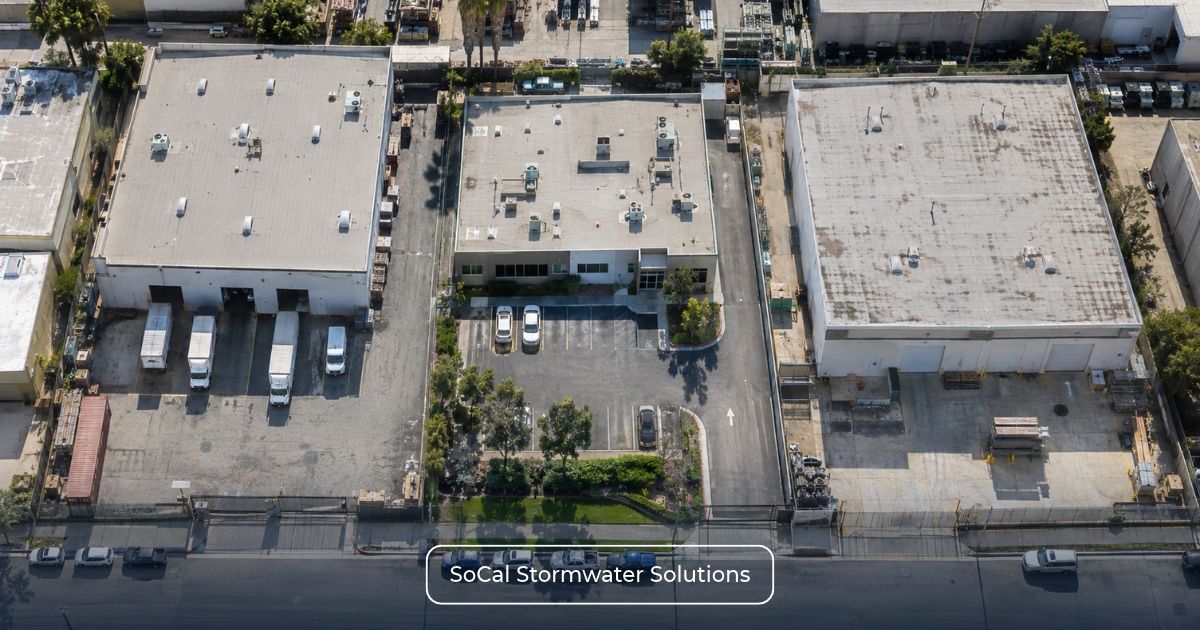
Attachment A defines a CII Site by reference to a privately owned parcel or contiguous parcels of land with qualifying Los Angeles County Assessor commercial, industrial, or institutional land-use classifications. This definition establishes the starting point for site applicability; it does not, by itself, determine whether permit coverage is required. The applicable watershed, acreage, ownership, existing-permit status, and other provisions must also be evaluated. 1
This definition makes physical parcel relationships relevant, but adjacency alone does not establish permit coverage. The review must also determine:
- Whether the parcels have qualifying Assessor land-use classifications;
- Whether they are privately owned;
- Whether they are located within a covered watershed;
- Whether residential or mixed-use limitations apply;
- Whether the relevant CII Site meets the applicable acreage threshold;
- Whether another NPDES stormwater permit covers any parcel or site area; and
- Whether another exclusion or permit-specific provision applies.
The CII Permit uses different acreage branches. A qualifying CII Site not covered by another NPDES stormwater permit is generally evaluated using five or more acres of impervious surface. A qualifying CII Site covered by another NPDES stormwater permit enters the branch using five or more acres of total area. The detailed measurement method belongs in Region 4 CII Permit 5-Acre Threshold: Does Your Property Need Coverage?
Los Angeles County Assessor records can help identify APNs and land-use codes, but assessor information alone does not determine stormwater coverage. Permit applicability also depends on ownership, watershed geography, parcel configuration, acreage, existing permit status, and the other provisions of the Order. 3
How does the CII permit treat multiple parcels?
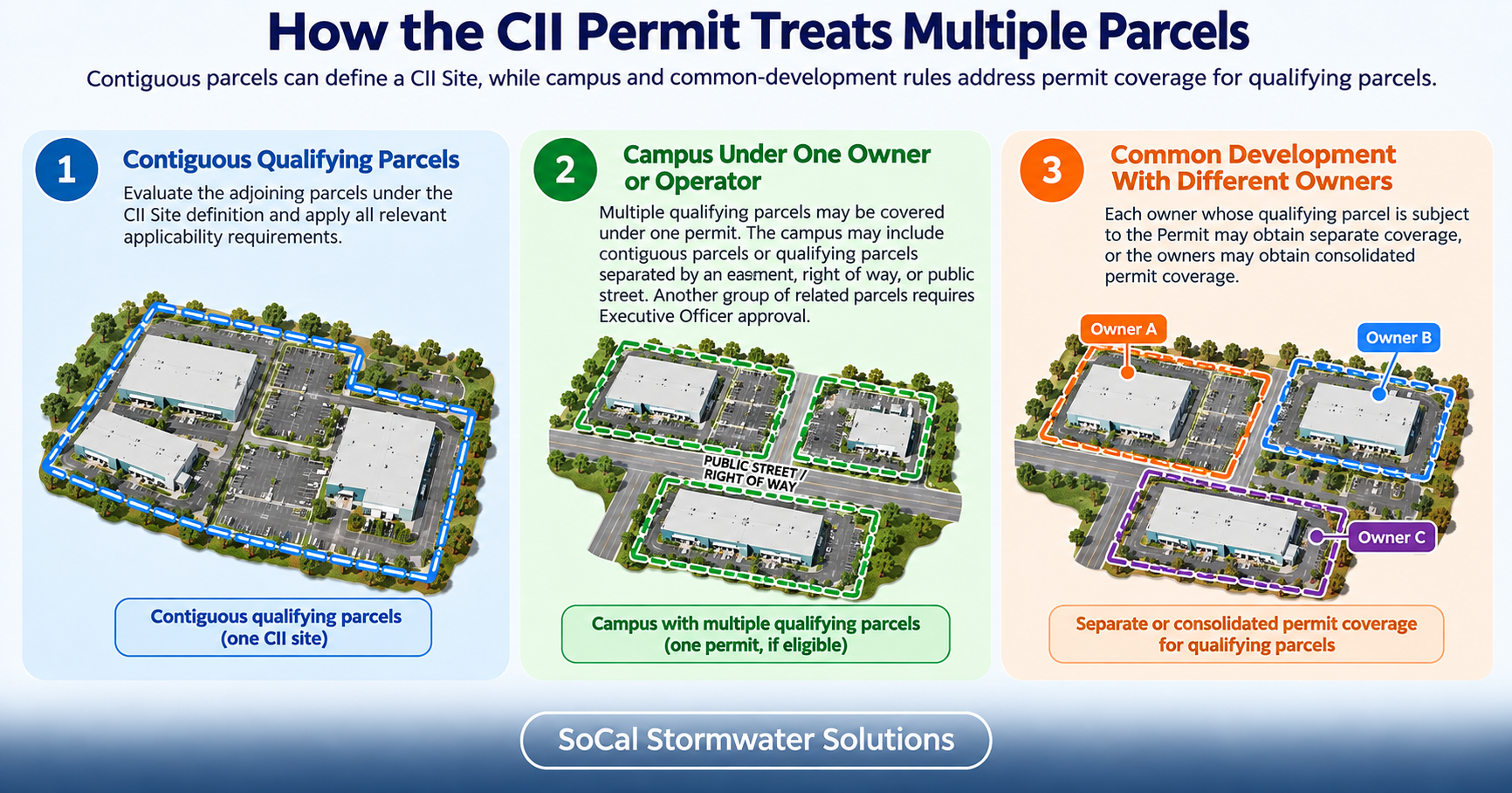
A multi-parcel analysis should classify the parcel relationship before selecting a permit structure. The visual below separates contiguous CII Site analysis from the administrative options available to campuses and common developments.
What is a “Campus” under the CII permit?
The campus provision applies when multiple qualifying parcels are owned or operated by one entity. Under Attachment A’s Discharger definition, that owner or operator may obtain one permit covering all qualifying parcels. The provision creates an available permit structure; it does not state that one campus permit is mandatory. 1
A campus may consist of:
- Contiguous parcels;
- Parcels separated by an easement;
- Parcels separated by a right of way;
- Parcels separated by a public street; or
- Another group of related parcels approved by the Executive Officer.
The campus rule applies only to qualifying parcels. Common ownership, shared branding, or coordinated operations do not make an otherwise non-qualifying parcel subject to the CII Permit. Where contiguous parcels form one qualifying CII Site, the Permit should not be read as imposing a separate acreage threshold on each parcel. Responsibility must still be determined under the Order’s Discharger provisions; campus status alone does not establish whether the owner or operator is responsible.
Can parcels across a street or easement be covered together?
Yes, potentially. The campus provision expressly recognizes qualifying parcels separated by an easement, right of way, or public street when the parcels are owned or operated by one entity. These separated parcels may be included in one campus permit structure. 1
This does not make parcels across a street “contiguous.” The correct distinction is:
- Physically adjoining qualifying parcels may be evaluated under the CII Site definition for contiguous parcels.
- Qualifying parcels separated by a listed feature may still be covered together through the campus provision.
- A different group of related parcels that does not fit the listed configurations requires Executive Officer approval before it is treated as a campus under this provision.
For separated parcels, verify the ownership or operator relationship, the separating feature, drainage and shared infrastructure, and any existing NPDES coverage before selecting a campus permit structure.
The Industrial Stormwater Permitting Process provides information about related permitting services. Any assistance with multi-parcel CII applicability or existing WDID reconciliation should be confirmed as part of the service scope.
What if different owners share a common development?
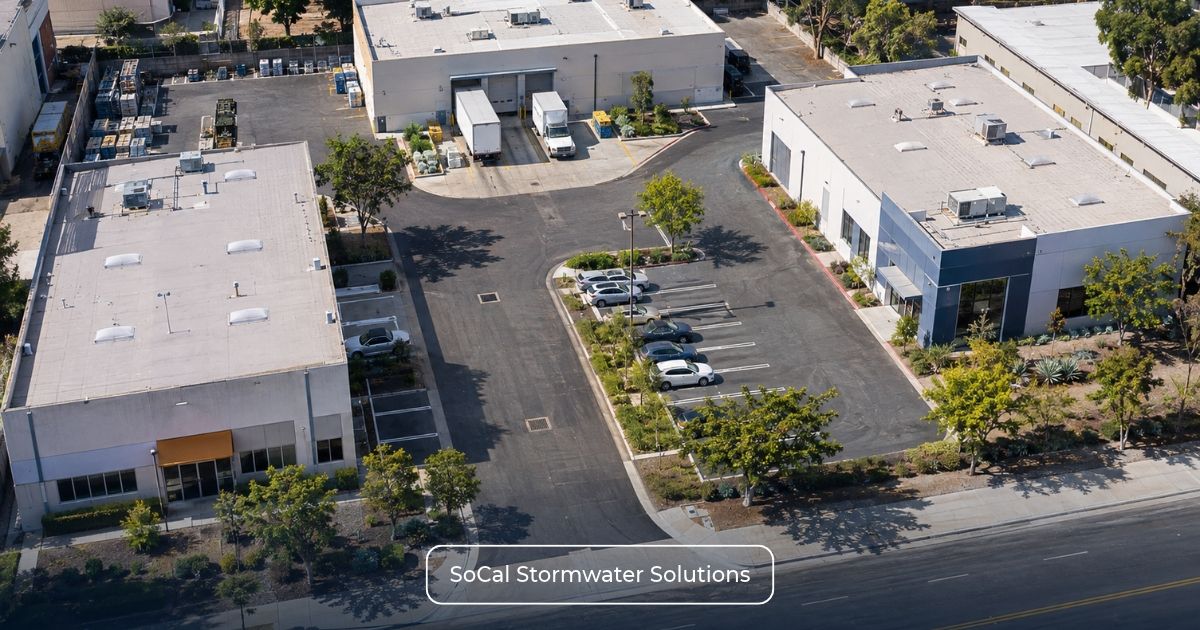
The Permit separately addresses qualifying parcels owned by different entities that form a common development. Each owner whose parcel is subject to the CII Permit may obtain separate coverage, or the owners may obtain consolidated permit coverage. Consolidation is an option, not a universal requirement. 1
A common development might include several separately owned commercial parcels that share internal roads, parking, landscaped areas, drainage infrastructure, or development management.
Before choosing separate or consolidated coverage, the parties should establish which parcels qualify, who owns and operates them, who controls common areas and shared drainage, whether existing permits affect any parcel, and which entity or entities can implement the required permit obligations.
The Permit does not require every owner in a common development to join one consolidated permit. It also does not state that consolidation erases parcel-specific qualification, ownership, or responsibility.
Different-Owner Common-Development Example
Assume two separately owned qualifying commercial parcels share an access road, parking area, and storm-drain system. If the parcels form a common development and are subject to the CII Permit, each owner may pursue separate coverage. Alternatively, the owners may use consolidated permit coverage if the structure can be implemented consistently with the Permit.
The administrative choice should follow—not replace—the applicability and responsibility analysis. Detailed allocation of legal or contractual duties belongs in “Region 4 CII Permit: Is the Property Owner or Tenant Responsible for Compliance?”
Once the appropriate permit structure has been determined, the responsible parties can identify the applicable enrollment and documentation requirements. For information about related administrative services, see SMARTS Permitting and Application Services. The availability of CII-specific enrollment assistance should be confirmed directly.
The distinctions among the three multi-parcel configurations are summarized below.
Contiguous CII Site vs Campus vs Common Development
These configurations address different aspects of CII applicability and permit administration. The comparison below shows what each configuration covers, how it functions, and which limitations still need to be evaluated.
|
Comparing CII Site, Campus, and Common Development Configurations |
|||
| Configuration | Who or What It Covers | Primary Role | Key Caution |
| Contiguous CII Site | A Privately Owned Qualifying Parcel or Contiguous Qualifying Parcels | Defines the CII Site for Applicability Analysis | Contiguity Does Not Replace Land-Use, Ownership, Watershed, Acreage, Residential, or Existing-Permit Requirements |
| Campus | Multiple Qualifying Parcels Owned or Operated by One Entity | May Allow One Permit to Cover All Qualifying Parcels | Parcels May Be Contiguous or Separated by an Easement, Right of Way, or Public Street; Other Related Groups Require Executive Officer Approval |
| Common Development | Qualifying Parcels Owned by Different Entities | Allows Separate Coverage or Consolidated Permit Coverage | Consolidation Is Optional and Does Not Erase Parcel-Specific Qualification, Ownership, or Responsibility |
Do campus or consolidated permit rules change the five-acre threshold?
The Permit defines CII Sites and separately establishes administrative options for campuses and common developments. The campus and common-development provisions address available permit-coverage arrangements. They should not be treated as independent authority to aggregate acreage across otherwise separate non-contiguous CII Sites for the purpose of meeting an applicability threshold. Any proposed aggregation must be supported by the applicable CII Site definition and the relevant acreage provisions of the Order.
The correct sequence is to identify the relevant CII Site, apply the appropriate Section 3.1.2 or 3.1.3 acreage branch, determine which parcels qualify, and only then consider whether campus or consolidated coverage is available. Do not combine acreage across otherwise separate non-contiguous parcels merely because they may later share one permit structure.
Example: Three Parcels Under One Operator
Assume Parcels A and B are adjoining qualifying parcels, while Parcel C lies across a public street and one entity operates all three. First determine whether A+B form the relevant CII Site and satisfy the applicable acreage and other requirements. Parcel C must be evaluated under its own site and threshold facts because the street separation does not make it contiguous with A+B.
If all three parcels independently qualify, the campus provision may allow one permit to cover them because one entity operates the parcels and the Order permits campus parcels to be separated by a public street. This does not mean A+B+C may automatically be combined to create CII applicability.
If an existing stormwater permit covers only part of one parcel or site, the separate physical coverage-gap analysis belongs in “CII Permit Rules for Partially Covered Properties”. Where a parcel has NONA or NEC status, the applicable status-specific rule should also be evaluated independently.
What should a multi-parcel property review before CII enrollment?
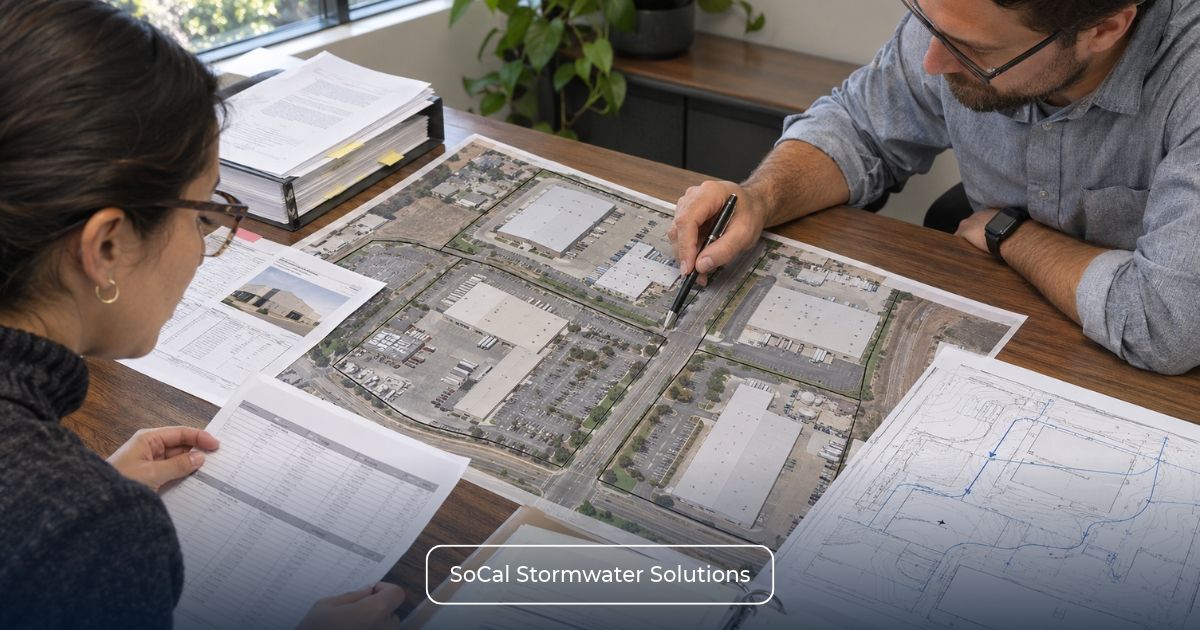
A multi-parcel property should be mapped before deciding how many permits to prepare. The review must distinguish parcel relationships, CII applicability, responsible entities, existing stormwater coverage, and available enrollment structures.
Multi-Parcel CII Review Checklist
Confirm:
- All APNs, parcel boundaries, assessor land-use codes, and ownership/operator information;
- Physical contiguity and any streets, easements, rights of way, or access corridors separating parcels;
- Covered-watershed location and applicable total or impervious acreage;
- Residential or mixed-use areas, where relevant;
- Existing NPDES, IGP, NEC, NONA, WDID, and permit status by parcel;
- Site drainage, shared infrastructure, discharge points, and common areas;
- Lease, operational-control, and authority-to-comply arrangements;
- Whether the parcels qualify as a campus or common development;
- Whether separate or consolidated coverage is appropriate; and
- Whether Executive Officer approval may be needed for another group of related parcels.
Shared drainage infrastructure, discharge points, BMPs, and operational boundaries may require additional field assessment when existing documentation does not adequately represent current conditions. Industrial Inspections and Monitoring provides information about related inspection and monitoring services. The scope of any multi-parcel CII assessment should be confirmed separately.
Where qualifying parcels will be addressed through a coordinated permit structure, existing site maps and SWPPP documentation may provide useful information for planning. Industrial SWPPP Services is a related resource, but CII-specific documentation assistance should not be assumed without confirmation.
The recommended sequence is map first, determine applicability second, identify the responsible entity third, and select the permit structure last.
Request a Multi-Parcel CII Review using the APNs, ownership and operator information, assessor classifications, parcel maps, acreage, drainage information, and existing permit records.