Having an active Industrial General Permit, another NPDES stormwater permit, or a Waste Discharge Identification number does not automatically exempt an entire property from the Region 4 Commercial, Industrial, and Institutional Stormwater Permit.
The relevant question is not simply whether the facility has a permit. The review must establish which portions of the qualifying CII site and associated stormwater discharges are covered by the existing permit and which portions, if any, remain subject to separate CII coverage requirements.
Order R4-2026-0226 has been adopted and is scheduled to become effective on October 31, 2026. Before changing an existing permit or preparing CII registration documents, facility operators should compare the full site with the exact scope of current NPDES coverage. 1

TL;DR
- An existing Industrial General Permit or other NPDES stormwater permit does not automatically exempt an entire property from the Region 4 CII Permit.
- A qualifying CII site already covered by another NPDES stormwater permit enters the branch based on five or more acres of total area.
- If the existing permit covers only part of the facility, section 3.1.3.3 requires CII coverage for the remaining portion when the other applicability requirements are met.
- An individual NPDES permit removes the need for separate CII coverage only when its requirements are at least as stringent as those in the CII Permit.
- A practical starting point is to compare the full qualifying CII site with the areas and stormwater discharges documented under the existing permit.
Does existing NPDES or IGP coverage exempt a facility from the Region 4 CII Permit?
No automatic property-wide exemption applies merely because a facility already has NPDES stormwater coverage.
Section 3.1.3 of the adopted CII Permit expressly addresses CII sites covered by another NPDES stormwater permit. When a site meets the other applicability criteria, this branch applies if the CII site has five or more acres of total area. 1
The property must still satisfy the relevant CII applicability requirements, including:
- Location within one of the two designated watershed areas.
- Classification as a qualifying privately owned CII site under the permit’s applicable land-use and site-definition provisions.
- Five or more acres of total area.
- The absence of a controlling permit exception.
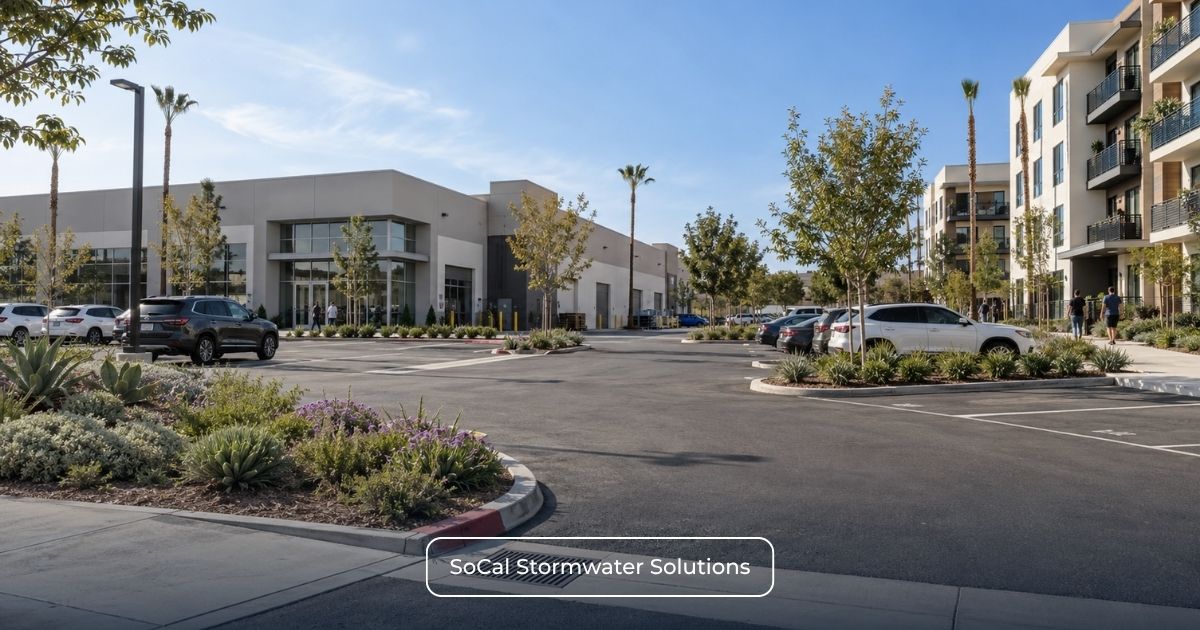
Mixed-use properties require additional attention. Under Attachment A, residential facilities are excluded from CII coverage, and specific rules apply to mixed-use parcels, buildings containing residential uses, shared parking, and common areas. The qualifying CII site boundary should therefore be established using the Order’s definitions rather than assuming that the entire parcel is covered. 1
A WDID confirms an administrative record for particular stormwater coverage. It does not, by itself, prove that every parcel, acre, activity, drainage area, or discharge associated with a larger property falls within that coverage.
The current California Industrial General Permit is Order 2014-0057-DWQ, as amended, under NPDES Permit CAS000001. Although its original expiration date has passed, it remains administratively continued until a replacement permit is issued. Existing IGP coverage therefore remains active and should be maintained according to its applicable requirements. 2
Facilities should preserve their established industrial compliance programs while separately determining whether any portion of the property requires CII coverage.
Why does the CII Permit use total area for already-permitted sites?
The adopted Order uses two different acreage branches based on the site’s existing NPDES stormwater status.
A qualifying CII site that is not covered by another NPDES stormwater permit is evaluated using five or more acres of impervious surface. A qualifying site that is already covered by another NPDES stormwater permit is evaluated using five or more acres of total area.
The existing-NPDES branch therefore should not be tested by measuring only rooftops and pavement. Total area may include both impervious and pervious portions within the applicable CII site boundary.
The comparison below identifies the correct starting point for each permit situation. It does not replace a property-specific review of watershed location, land-use classification, ownership, parcel configuration, or an applicable exclusion.
Region 4 CII Acreage Branches by Existing Permit Status |
||
|---|---|---|
| Existing Permit Situation | Applicable Acreage Basis | Primary Review Question |
| No Other NPDES Stormwater Permit | Five or More Acres of Impervious Surface | Does the qualifying CII site meet the threshold for sites not covered by another NPDES stormwater permit? |
| Existing IGP or Other NPDES Stormwater Permit | Five or More Acres of Total Area | What is the full CII site, and what does the existing permit actually cover? |
| Partial NPDES Stormwater Coverage | Five or More Acres of Total Area, Subject to the Other Applicability Requirements | Which portion remains outside the existing permit coverage? |
| Individual NPDES Permit | Section 3.1.4 Exception, Subject to Permit-Specific Review | Does the individual permit contain requirements at least as stringent as the CII Permit? |
Detailed measurement rules, contiguous-parcel analysis, and the distinction between total and impervious acreage belong in Region 4 CII Permit 5-Acre Threshold: Does Your Property Need Coverage? This article focuses on why an existing NPDES permit sends the property into the total-area branch and why actual permit boundaries must be reviewed.
Does your existing Stormwater Permit cover the entire CII Site?
A permit-boundary audit compares the complete CII site with the actual area, activities, drainage, and discharges addressed by the existing permit.
“Permit footprint” is useful shorthand for this review, but it is not a defined term in Order R4-2026-0226. The conclusion should come from the current NOI or individual permit, SMARTS record, SWPPP, site map, drainage information, and other controlling documents.
Does Your Existing Stormwater Permit Cover the Whole CII Site?
The following three-layer framework is a practical method for organizing a permit-boundary review. It is not a Water Board-prescribed classification or mapping procedure.
Layer 1 — Full CII Site
Identify the qualifying property, parcels or contiguous parcels, total acreage, buildings, tenant areas, common areas, and drainage system.
Layer 2 — Existing NPDES Permit Footprint
Map the operations, drainage areas, discharge points, and property portions actually addressed by the existing IGP or other NPDES permit.
Layer 3 — Remaining Area Requiring CII Review
Identify rooftops, parking, drive aisles, common areas, tenant areas, or other portions not resolved by the existing permit scope, then apply the remaining CII applicability requirements.
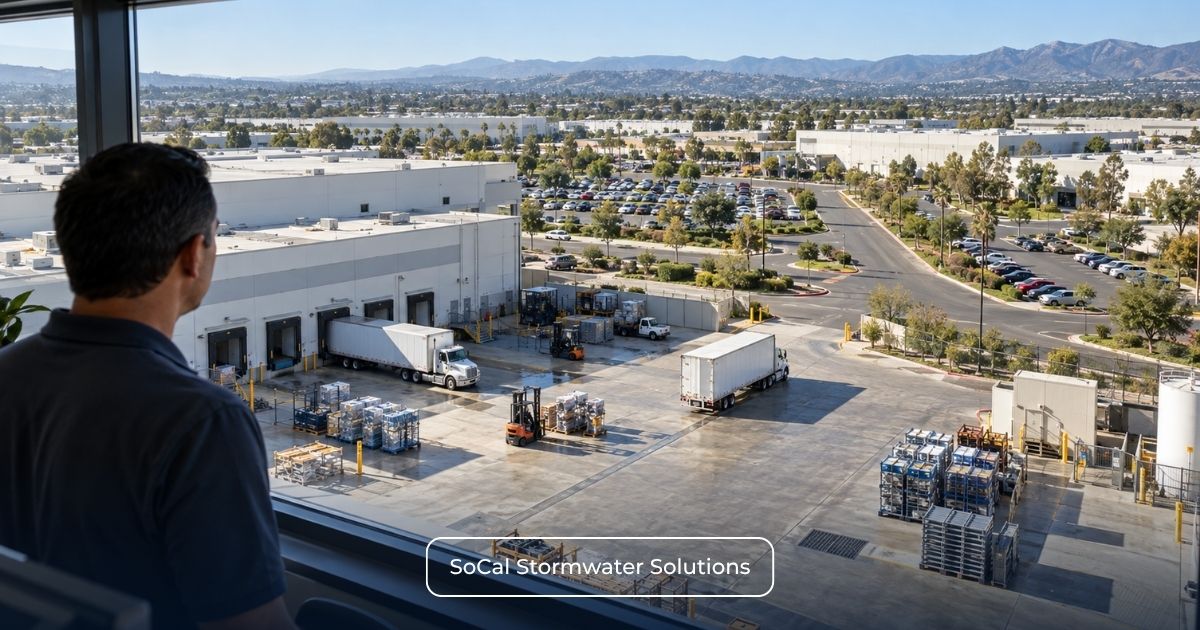
Consider an industrial property with regulated operations in a warehouse and outdoor production yard. Its Industrial SWPPP may focus on industrial material areas, drainage areas, BMPs, and discharge locations associated with those regulated activities.
The same property may also include a large roof, employee and visitor parking, internal drive aisles, landscaped areas, shared access areas, or tenant space. Those areas should not automatically be treated as inside or outside the IGP merely from their appearance. Their status should be determined from the controlling permit documents, documented facility boundaries, applicable industrial activities, and actual drainage configuration.
The review should reconcile the parcel and CII site boundaries with the current Industrial SWPPP or other permit documents, drainage areas and discharge points, tenant or common areas, and any portions covered by another stormwater permit. Roof, parking, paved-area, and shared-area drainage should also be checked where relevant.
Industrial SWPPP Services can support existing IGP facilities with permit-document and site-plan review when the industrial compliance boundary needs to be reconciled with the broader CII analysis.
What happens when only part of the facility is covered by another NPDES Permit?
Section 3.1.3.3 addresses partial coverage. When another NPDES stormwater permit covers only part of a facility, the adopted CII Permit requires coverage for the remaining portion if the site otherwise meets the CII applicability requirements. 1
This does not mean that every square foot outside an Industrial SWPPP boundary automatically requires separate CII coverage. The site must still fall within one of the two designated watersheds, qualify as a privately owned CII site, satisfy the five-or-more-acres-of-total-area branch, and remain outside any applicable exclusion.
For example, an existing NPDES permit may clearly cover an industrial operations yard and its associated discharge points while leaving parking, rooftops, internal roads, or common drainage areas outside that documented scope. The facility should map the covered portion against the full qualifying CII site, identify the remaining area and drainage system, and then apply the CII geography, ownership, acreage, and exclusion requirements to that remainder.
Where both programs apply, coordinating site maps, BMP responsibilities, inspection records, and monitoring information can help distinguish the requirements associated with each permit. This coordination does not replace either permit’s independently applicable obligations.
Industrial Inspections and Monitoring can support the field review of drainage areas, existing controls, discharge locations, and operational conditions relevant to that coordination.
What about IGP NEC and NONA facilities?
The adopted CII Permit contains specific acreage provisions for facilities with a No Exposure Certification or Notice of Non-Applicability under the Industrial General Permit.
Those statuses should not be treated as automatic property-wide CII exemptions. They also should not be collapsed into the general partial-coverage rule without reviewing the provisions written specifically for them.
In summary:
- For a qualifying NEC facility subject to Section 3.1.3.1, the CII Permit requires coverage for the acreage covered by the NEC.
- For a qualifying NONA facility subject to Section 3.1.3.2, the CII Permit requires coverage for acreage not covered by the NONA. 1
- These status-specific provisions apply to facilities that meet the CII Permit’s applicable watershed, site-definition, ownership, acreage, and other eligibility requirements.
The detailed distinction belongs in “Already Have IGP Coverage, an NEC, or a NONA? How the Region 4 CII Permit Applies” blog and the related NEC- and NONA-specific articles. Facility operators should review those rules before modifying or terminating an existing IGP status.
When can an individual NPDES Permit remove the need for CII coverage?

Section 3.1.4 provides a narrower exception for certain individually permitted facilities.
A facility with an individual NPDES permit is not required to obtain separate coverage under the CII General Permit when the individual permit contains requirements that are at least as stringent as the CII Permit. 1
The existence of an individual NPDES permit is not enough by itself. The actual permit should be reviewed for its coverage scope, effluent limitations, stormwater controls, monitoring, inspections, reporting, and recordkeeping requirements before relying on the Section 3.1.4 exception. A facility should not assume equivalency from the permit type, name, age, or NPDES number. Where the comparison is unclear, the issue may require confirmation with the Los Angeles Water Board.
The individual-permit exception should also be distinguished from ordinary IGP coverage. The IGP is a statewide general permit, while section 3.1.4 specifically refers to an individual NPDES permit meeting the required stringency standard.
How should an existing NPDES or IGP facility check CII coverage?
A practical coverage review should compare the existing permit documents with the full CII site rather than assuming that one WDID establishes property-wide coverage. Review:
- the facility address, parcels, watershed location, CII classification, ownership, and total acreage;
- the current WDID, NPDES permit type, NOI or individual permit, and Industrial SWPPP where applicable;
- documented permit boundaries, drainage areas, flow paths, and discharge points;
- roof, parking, tenant, common-area, or other portions that may fall outside the existing permit scope; and
- any active NEC, NONA, partial-coverage condition, or potentially qualifying individual NPDES permit.
An owner/operator review may also be necessary when the existing NPDES permittee is not the same entity that may qualify as the CII Discharger. That responsibility question belongs in Region 4 CII Permit: Is the Property Owner or Tenant Responsible for Compliance?
Clarify Existing NPDES and CII Coverage
An existing NPDES permit does not necessarily resolve coverage for every portion of a qualifying CII property. Reviewing the current permit’s documented scope alongside the CII Permit’s applicability provisions can help identify areas requiring further evaluation.
For related permitting assistance, see SMARTS Permitting and Application Services or contact SoCal Stormwater Solutions.