Discovering a Numeric Action Level exceedance at an industrial facility in Los Angeles can create operational uncertainty for plant managers, facility operators, EHS teams, and civil engineers. Under California’s Industrial Stormwater Program and Industrial General Permit, the same ERA and SMARTS requirements may also affect facilities in Orange, Anaheim, Santa Ana, Irvine, Riverside, San Bernardino, San Diego, and other California communities.
A Numeric Action Level exceedance alone does not constitute a permit violation; however, failure to complete required ERA actions, reporting, or BMP modifications required by the permit may constitute a permit violation.
Managing an exceedance requires coordinated attention to sampling information, documentation responsibilities, reporting workflows, and facility conditions. SoCal Stormwater Solutions can assist with required documentation and reporting, stormwater sampling coordination, QISP-supported evaluations, and ERA documentation for industrial facilities in Los Angeles, Orange, Anaheim, Santa Ana, Irvine, Riverside, San Bernardino, San Diego, and other California locations.

TL;DR
- A Numeric Action Level exceedance serves as a corrective response trigger requiring evaluation, documentation, and applicable actions under the Industrial General Permit framework.
- Exceedance Response Action (ERA) processes provide a structured pathway for evaluating conditions, addressing contributing factors, and completing required reporting activities.
- SMARTS supports electronic reporting workflows for applicable Industrial General Permit submissions, including required ERA reports, certifications, and related documentation.
- Industrial General Permit NAL evaluations may use different calculation methods, including Annual Average and Instantaneous Maximum criteria, depending on the applicable parameter requirements.
Understanding NAL Exceedances under the Industrial General Permit
After a stormwater sample exceeds an applicable Numeric Action Level under California’s Industrial General Permit framework, facility operators must determine what the result means and which response steps apply. Facility teams must evaluate the sampling information, complete applicable documentation, and address required response actions based on permit requirements and site conditions.
A Numeric Action Level exceedance occurs when measured stormwater results exceed an applicable Numeric Action Level established under the Industrial General Permit. The exceedance itself is not a permit violation, but required Exceedance Response Action (ERA) activities, reporting, or BMP corrective actions that are not completed as required by the permit may constitute a violation.
The response process focuses on evaluating contributing conditions, documenting findings, and implementing applicable corrective measures as part of a broader stormwater risk management approach. For additional context on permit planning and compliance frameworks, refer to The Ultimate California Stormwater Compliance Handbook: SWPPP, Permits, and Risk Management. For industrial facilities in Los Angeles, Orange, Anaheim, Santa Ana, Irvine, Riverside, San Bernardino, and San Diego, understanding the distinction between an exceedance and a violation helps teams organize the required evaluation and documentation process.
SoCal Stormwater Solutions can assist with permit-related documentation and reporting, sampling coordination, and site-specific guidance based on applicable requirements.
Annual Average vs. Instantaneous Maximum Triggers under the Industrial General Permit
Numeric Action Level evaluation under California’s Industrial General Permit depends on the calculation method established for the applicable parameter. Understanding the difference between Annual Average and Instantaneous Maximum evaluations helps facility managers, operations teams, contractors, and project stakeholders interpret stormwater sampling results and determine which response steps may apply under the Industrial General Permit.
The reporting period follows the July 1 through June 30 reporting year, while parameter-specific permit provisions determine how results are evaluated and whether Exceedance Response Action (ERA) activities, documentation, or corrective measures apply. Annual Average evaluations generally consider applicable analytical results collected throughout the reporting year, while Instantaneous Maximum evaluations are based on parameter-specific limits and calculation requirements established by the permit.
| Evaluation Metric | Parameter Focus | Trigger Threshold | Calculation Frequency |
| Annual Average NAL | Parameters Listed with Annual NAL Values, Including TSS and Oil & Grease | Exceedance occurs when the average of all analytical results for a parameter during the July 1–June 30 reporting year exceeds the applicable annual NAL. Examples include TSS at 100 mg/L and Oil & Grease at 15 mg/L. | Calculated Across the Full Reporting Year Using Applicable Sampling Data |
| Instantaneous Maximum NAL | Parameters with Instantaneous Maximum Limits, Including TSS, Oil & Grease, and pH | Exceedance occurs when two or more analytical results for the same parameter in one reporting year exceed the instantaneous maximum NAL, or fall outside the pH range. Examples include TSS at 400 mg/L, Oil & Grease at 25 mg/L, and pH below 6.0 or above 9.0. | Evaluated by Individual Analytical Results within the July 1–June 30 Reporting Year |
| TMDL-related TNAL / NEL | Parameters Tied to Applicable TMDL Requirements | Additional thresholds may apply where a facility is a Responsible Discharger under applicable TMDL provisions. TNALs and NELs are evaluated separately from baseline NALs. | Depends on the Applicable TMDL Requirement and Permit Provisions |
Total Suspended Solids (TSS)
Total Suspended Solids (TSS) is one of the monitored parameters evaluated under the Industrial General Permit. Depending on the applicable permit requirements, TSS may be evaluated using parameter-specific NAL calculation methods, including Annual Average or Instantaneous Maximum criteria where applicable.
pH
pH is evaluated as a monitored parameter under the Industrial General Permit. The applicable thresholds and calculation methods depend on current permit provisions and the specific NAL category that applies to the evaluation.
Specific Conductance
Specific Conductance may be relevant where required by facility-specific, regional, receiving-water, TMDL, or other applicable permit conditions. It should not be treated as a universal baseline monitoring parameter for every facility.
Oil and Grease
Oil and Grease requirements may apply under specific Industrial General Permit provisions. Applicable evaluation methods depend on the requirements associated with the parameter.
A Numeric Action Level exceedance is not itself a permit violation. Applicable response actions, reporting, and corrective measures depend on Industrial General Permit requirements. Facilities may need to evaluate conditions, maintain documentation, and complete Exceedance Response Action (ERA) activities where applicable. Facilities seeking NAL response support can receive assistance with required documentation and reporting, sampling coordination, and industrial facility inspections and monitoring services, along with site-specific guidance based on facility conditions and applicable requirements.
The Level 1 Exceedance Response Action (ERA) Timeline

A facility may progress to Level 1 ERA requirements when applicable Industrial General Permit criteria are met following a Numeric Action Level (NAL) evaluation. The Level 1 ERA process involves technical evaluation, documentation, and reporting obligations that must be managed according to the applicable permit framework.
Following assignment of Level 1 status under the Industrial General Permit, facilities organize evaluation activities, review site conditions, and complete required electronic reporting steps.
The Stormwater Multiple Application and Report Tracking System (SMARTS) assigns a facility’s regulatory Level status annually on July 1 based on required monitoring data submitted into the system. However, SMARTS notifications are not a substitute for the facility’s own tracking obligations. Dischargers remain responsible for reviewing sampling results, identifying applicable ERA triggers, and demonstrating permit compliance.
- July 1: Level status changes. SMARTS assigns regulatory Level status annually on July 1 based on required monitoring data from the prior reporting year, but the facility remains responsible for tracking results and determining applicable ERA obligations.
- By October 1: Complete the Level 1 ERA Evaluation. When Level 1 requirements apply, the discharger must complete an evaluation with QISP assistance. The evaluation reviews pollutant sources, drainage areas, existing BMPs, and SWPPP revisions or additional BMPs needed to address the parameter that exceeded the NAL or TNAL.
- By January 1: Submit the Level 1 ERA Report through SMARTS. The Level 1 ERA Report must be prepared by a QISP, certified, and submitted through SMARTS. The report summarizes the evaluation, describes SWPPP revisions and additional BMPs, and includes required QISP information.
Moving to Level 2 Status under the Industrial General Permit: Technical Demands and Action Plans

Level 2 requirements under California’s Industrial General Permit apply when a facility meets the specific permit criteria for progression to Level 2 status. Progression through the Exceedance Response Action (ERA) process following a Numeric Action Level exceedance depends on permit-defined conditions, exceedance history, and other applicable requirements rather than occurring automatically after every Numeric Action Level result.
The Level 2 ERA Action Plan and Level 2 ERA Technical Report document the facility’s evaluation, planned corrective measures, and required technical information when Level 2 ERA requirements apply under the permit.
When Level 2 criteria apply, the facility may need additional technical evaluation, documentation, and assessment of existing Best Management Practices (BMPs). This process helps identify contributing pollutant sources, evaluate current controls, and determine whether additional corrective-action planning is needed based on site conditions and applicable permit requirements.
Level 2 ERA Requirements
The Level 2 ERA process includes preparation of a Level 2 ERA Action Plan and a Level 2 ERA Technical Report when required under the Industrial General Permit. These documents evaluate contributing pollutant sources, assess existing Best Management Practices (BMPs), and identify potential additional controls or BMP modifications where required by the permit evaluation.
A Level 2 evaluation focuses on documenting site conditions, reviewing implemented measures, and outlining corrective actions or planned improvements where required. The process evaluates whether additional controls or BMP modifications are needed based on site conditions and permit requirements rather than applying a single solution to every facility.
When Level 2 status applies, the discharger must obtain QISP assistance for the Level 2 ERA process. The Level 2 ERA Action Plan must be certified and submitted into SMARTS by January 1 of the following reporting year, after Level 2 status is determined. The Level 2 ERA Technical Report is then due by January 1 following submission of the Level 2 ERA Action Plan. Required Action Plan elements must be implemented as soon as practicable and completed no later than one year after the Action Plan is submitted.
Hypothetical Operational Case Study

Consider a hypothetical industrial yard in the City of Orange where recurring Total Suspended Solids (TSS) results prompt further evaluation under the Industrial General Permit. The facility team reviews potential pollutant sources, examines existing Best Management Practices (BMPs), identifies potential gaps in current controls, and evaluates whether targeted BMP modifications or operational adjustments should be considered.
As part of the review process, the facility assesses possible improvements such as additional source controls, revised operational practices, or other BMP modifications where appropriate. The evaluation focuses on identifying contributing factors and documenting corrective-action planning rather than assuming a specific outcome.
Data Verification Note: Any percentage reduction values, sampling trends, or performance measurements must be verified against current monitoring data or approved technical sources before publication.
Best Management Practices to Address Sampling Anomalies
When stormwater sampling results indicate potential concerns under the Industrial General Permit, Best Management Practices (BMPs) can be evaluated as operational measures to help identify and address stormwater-management needs. BMP selection depends on site conditions, identified pollutant sources, facility operations, and applicable permit requirements.
A Numeric Action Level (NAL) exceedance or applicable Exceedance Response Action (ERA) requirements may require evaluation of existing controls, but no individual BMP should be viewed as a universal solution or guaranteed corrective measure.
Structural Source Controls
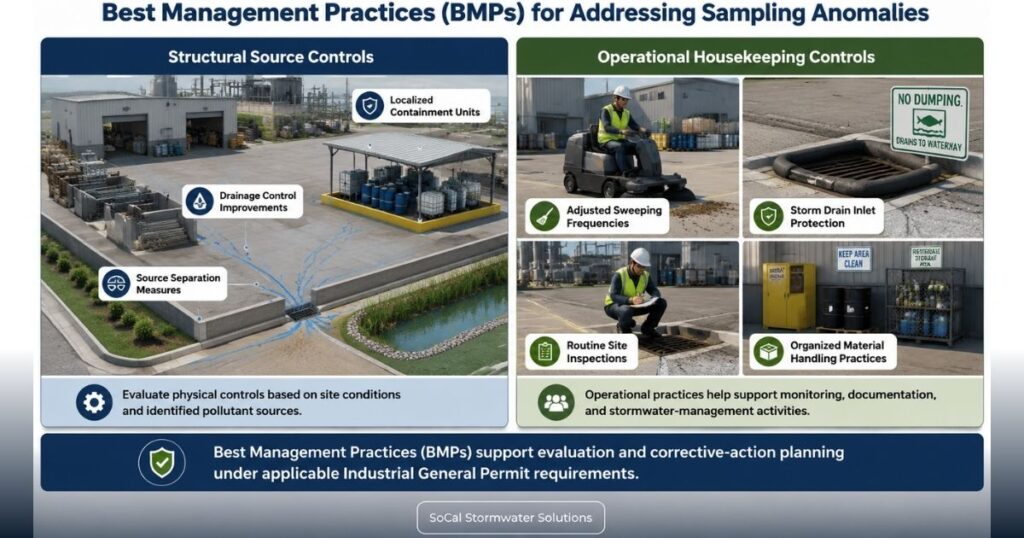
Structural source controls focus on physical measures that address identified pollutant pathways and site-specific conditions. Examples may include localized containment measures, drainage control improvements, physical source separation practices, and other controls evaluated based on facility operations and potential pollutant sources.
For facilities evaluating parameters such as Total Suspended Solids (TSS), structural BMP considerations should be connected to documented site conditions and the specific stormwater-management needs identified through evaluation activities. These measures may help facilities address identified stormwater-management needs and support implementation of applicable permit requirements when evaluated and implemented based on site conditions.
Operational Housekeeping Controls
Operational housekeeping controls focus on routine facility practices that support ongoing stormwater management activities. Examples may include adjusting sweeping frequencies where appropriate, improving material handling practices, maintaining storm drain inlet protection, and strengthening inspection procedures.
These practices can support preparation for inspections, monitoring, and reporting obligations by helping facilities document site conditions and evaluate whether operational adjustments are needed. Routine industrial facility inspections and monitoring services can assist with identifying conditions that require attention, while sampling coordination and documentation assistance can support the evaluation process.
SoCal Stormwater Solutions provides operational support through industrial facility inspections and monitoring services, sampling coordination, documentation assistance, and site-specific guidance based on facility conditions and applicable requirements. These services can help teams organize field information and address stormwater-management needs during ongoing BMP evaluation activities.
BMP evaluation is site-specific and should be based on applicable Industrial General Permit requirements, facility conditions, identified pollutant sources, and operational considerations.