Stormwater sampling errors do not begin and end with the bottle. A result can become unreliable or incorrectly interpreted when a facility applies the wrong permit requirement, samples a non-qualifying event, uses an unrepresentative discharge location, misses the collection window, breaks the chain of custody, requests the wrong laboratory method, or reports the data incorrectly in SMARTS.
An unexpected laboratory result therefore requires two separate reviews. The first is a Sample Validity Review, which examines whether the event, discharge point, collection process, field records, laboratory analysis, and reporting record are defensible. The second is a Discharge Compliance Review, which determines what a valid result indicates about pollutant sources, Best Management Practice (BMP) performance, and the facility’s applicable permit obligations.
This distinction is especially important when interpreting Numeric Action Levels (NALs), TMDL Numeric Action Levels (TNALs), and Numeric Effluent Limitations (NELs). NAL and TNAL exceedances are not, by themselves, violations of California’s Industrial General Permit. Failure to complete applicable Exceedance Response Action requirements can constitute noncompliance. An exceedance of an applicable NEL is a permit violation, but NEL applicability and the permit-defined exceedance criteria must first be confirmed.
This guide follows the evidence chain from Qualifying Storm Event (QSE) confirmation and discharge-location selection through sample handling, laboratory coordination, SMARTS reporting, and regulatory classification. The goal is to determine whether the data are valid, preserve the original record, classify the result correctly, and address actual discharge conditions when follow-up is required.
Permit Status Note: As verified on August 18, 2026, Order 2014-0057-DWQ, as amended in 2015 and 2018, remains the operative statewide Industrial General Permit. It expired on June 30, 2020, but is administratively continued until a new permit is issued. This status should be rechecked immediately before publication and during future substantive updates.

TL;DR
- Freeze the Record: Preserve the original field log, photographs, chain of custody, calibration record, laboratory report, discharge-location identity, and SMARTS record. Do not reconstruct the event after receiving a high result.
- Identify the Threshold: Determine whether the result must be evaluated against an annual NAL, instantaneous maximum NAL or TNAL, applicable NEL, or federal effluent limitation.
- Validate the Sample: Review QSE eligibility, discharge representativeness, collection timing, visual observations, bottle handling, preservation, pH timing, calibration, chain of custody, holding time, analytical method, and units.
- Validate the Discharge: If the result is valid, trace the affected drainage area to industrial activities, exposed materials, spills, sediment, oils, metals, housekeeping conditions, and BMP performance.
- Report and Escalate: Preserve the original result, meet the applicable SMARTS deadline, and obtain qualified technical support when ERA, NEL, TMDL, receiving-water, or unresolved data-quality requirements apply.
Why Stormwater Sampling Errors Matter Beyond the Bottle
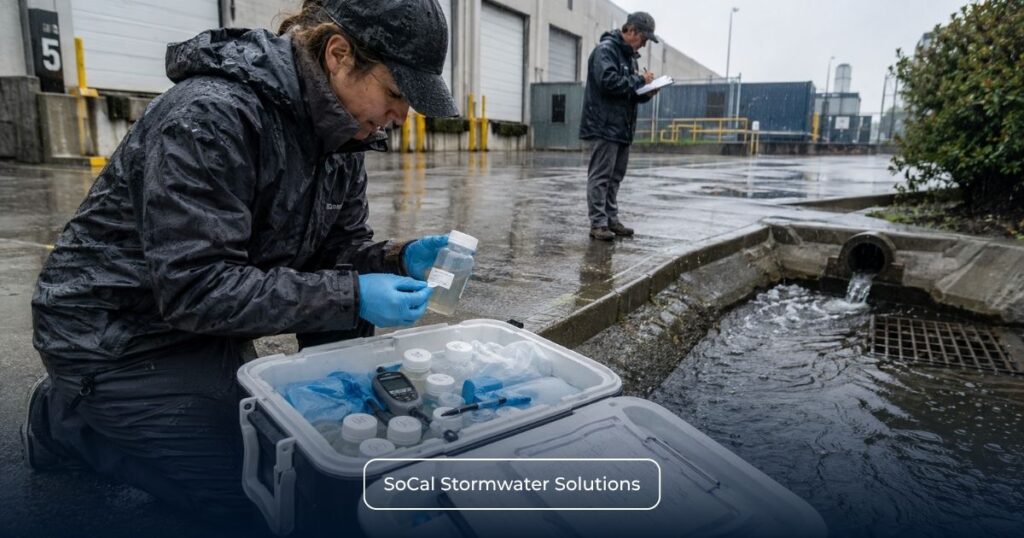
A stormwater result is defensible only when the facility can connect it to the correct permit requirement, qualifying event, drainage area, discharge location, collection time, field observations, sample container, custody record, analytical method, and SMARTS submission. A failure at any point can affect representativeness, reporting accuracy, or regulatory classification.
The evidence chain begins before sample collection:
Permit coverage → QSE → drainage area → discharge location → collection time → field observations → container → field instrument → chain of custody → laboratory analysis → SMARTS → compliance classification
Starting with the bottle skips several decisions that determine whether the sample should have been collected, where it should have been taken, which parameters required analysis, and which numeric requirements apply.
For example, a laboratory may correctly analyze a sample collected from an undocumented convenience point rather than a permit-identified discharge location. The concentration may accurately describe the water inside the bottle while failing to represent the industrial stormwater discharge the facility was required to monitor.
The opposite problem is equally important. A facility may identify a documentation defect after receiving a high result and assume that the result can be disregarded. That conclusion should not be made without reviewing the nature of the defect, original records, field conditions, and reporting requirements.
Stormwater sampling is one part of the wider relationship among monitoring, laboratory analysis, and electronic reporting addressed in Mastering SMARTS and Stormwater Sampling: Defending Against Water Board Violations.
No Result-Shopping Rule: Additional sampling does not erase a valid original result. Facilities should not delay collection to seek dilution, move to a cleaner sampling point, discard unfavorable data, or rewrite field records after receiving laboratory results.
First: Is the facility comparing the result to the right numeric requirement?
A laboratory result cannot be classified correctly until the facility identifies the applicable permit provision, parameter, receiving water, TMDL, compliance date, SIC code, and federal Effluent Limitation Guideline. California industrial facilities do not all share the same numeric requirements, and no universal NEL value applies statewide.
The broader relationship among permit coverage, SWPPP implementation, monitoring, and reporting is explained in the California Stormwater Compliance Handbook. For the immediate result review, the facility must identify which regulatory construct applies.
NAL, TNAL, NEL, and ELG Classification |
|||
|---|---|---|---|
| Requirement | Official Source | Evaluation Method | Compliance Meaning |
| Annual NAL | IGP Table 2 and §XII.A | Average of All Applicable Analytical Results for the Parameter Across the Facility During the July 1–June 30 Reporting Year | Can Trigger ERA Requirements But Is Not, by Itself, a Violation |
| Instantaneous Maximum NAL | IGP Table 2 and §XII.A | Two or More Results During the Reporting Year Exceed the Applicable Instantaneous Maximum Value, or Two or More pH Results Fall Outside the Range | Can Trigger ERA Requirements But Is Not, by Itself, a Violation |
| TNAL | Attachment E Table E-2 and §V.C.2 | Two or More Results for a Parameter During the Reporting Year Exceed the Applicable Instantaneous Maximum TNAL | A TNAL Exceedance Is Not, by Itself, a Permit Violation; Applicable ERA and TMDL Requirements Still Apply |
| NEL | Attachment E Table E-2 and §V.C.1 | Two or More Results for a Parameter During the Reporting Year Exceed the Applicable Instantaneous Maximum NEL | A Permit-Defined Exceedance of an Applicable, Effective NEL Is a Violation |
| Federal ELG | Subchapter N and IGP Attachment F | Depends on the Applicable Industry-Specific Effluent Limitation and Monitoring Requirement | Facility Must Comply with the Applicable Federal Numeric and Procedural Requirements |
The statewide Table 2 values include:
- TSS: 100 mg/L annual NAL and 400 mg/L instantaneous maximum NAL;
- Oil and Grease: 15 mg/L annual NAL and 25 mg/L instantaneous maximum NAL; and
- pH: instantaneous maximum range below 6.0 or above 9.0.
Additional Table 2 parameters have annual NALs based on the applicable facility monitoring requirements.1
TMDL-specific TNALs and NELs must be identified using the facility’s receiving water, discharged pollutants, status as a Responsible Discharger, applicable requirement, and effective date in Attachment E. The Water Boards’ mapping tool can support the review, but the State Water Board states that the discharger remains responsible for identifying applicable TMDL requirements.
Compliance Distinction: A single result above an instantaneous numeric threshold does not, by itself, establish an instantaneous maximum NAL, TNAL, or NEL exceedance. Annual NAL status is determined separately from the average of all applicable analytical results for the parameter during the reporting year.
If the applicable threshold or Attachment E status remains unclear, preserve the original monitoring record and obtain a qualified technical review before classifying the result or determining the required response.
Error 1: Using QPE Logic Instead of the IGP Qualifying Storm Event Rule
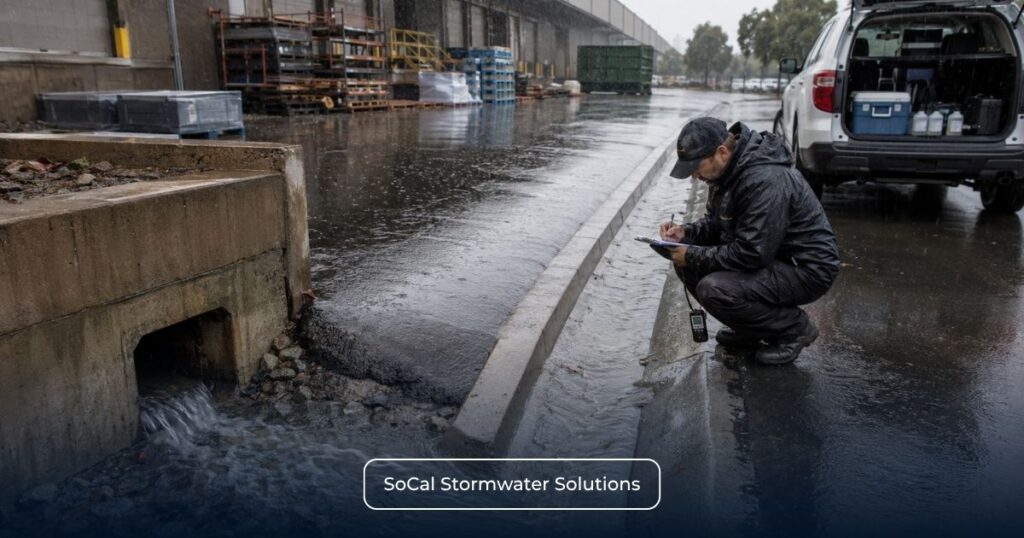
California’s Industrial General Permit uses the term Qualifying Storm Event, or QSE. A QSE is a precipitation event that produces a discharge from at least one drainage area and is preceded by 48 hours with no discharge from any drainage area. The IGP definition does not contain a blanket 0.5-inch rainfall threshold. 1
Weather forecasts can help facilities prepare personnel, bottles, instruments, and laboratory pickup. QSE status, however, depends on actual discharge and the preceding no-discharge condition.
Under the standard framework, the discharger collects and analyses samples from:
- two QSEs from July 1 through December 31; and
- two QSEs from January 1 through June 30.
Compliance Group participants ordinarily sample one QSE in each reporting-year half. 1
A certified Sampling Frequency Reduction can change this framework when the permit criteria are met. The Regional Water Board can reject the certification or request additional support, and an NAL, TNAL, or NEL exceedance causes the facility to lose the reduction.1
A Compliance Group participant that also qualifies for a certified Sampling Frequency Reduction is required to sample one QSE during the reporting year.
The QSE record should identify:
- discharge date and time;
- affected drainage area;
- preceding 48-hour no-discharge condition;
- applicable reporting-year half;
- scheduled facility operating hours;
- safety conditions; and
- any permit-recognized reason a required sample was not collected.
Facilities that also manage construction projects should note that the Construction General Permit uses a different precipitation-event framework. For that separate permitting context, see Preparing for a Qualifying Precipitation Event (QPE): A Stormwater Sampling Checklist.
Error 2: Missing the Required Four-Hour Sampling Window
Samples from each applicable discharge location must be collected within four hours of discharge starting. If a QSE begins during the preceding 12 hours outside scheduled operating hours, the four-hour period begins when scheduled operations start. Sampling is required during scheduled operating hours and when conditions are safe.1
Four-Hour Sampling Timing Record |
||
|---|---|---|
| Evidence Field | Required Record | Purpose |
| Discharge Start | Date and Time Discharge Began | Establishes the Ordinary Collection Window |
| Facility Hours | Scheduled Operating Times | Supports Application of the Overnight Provision |
| Sample Time | Exact Time at Each Discharge Point | Shows Whether Collection Occurred in the Applicable Period |
| Collector | Name of Sampler | Connects the Sample with the Event Record |
| Applicable Exception | Specific Safety or Operating-Hours Condition | Supports Required Annual Report Explanation |
The permit does not establish a general extension for staff shortages, unavailable bottles, late mobilization, or laboratory scheduling problems.
Sampling and visual observations are not required during dangerous conditions such as flooding or electrical storms or outside scheduled operating hours. If one of these exceptions prevents completion, the explanation must be included in the Annual Report.1
Error 3: Sampling the Wrong Discharge Point
Except where an authorized reduction or alternative applies, samples must be collected from every drainage area at all discharge locations. Samples must represent stormwater associated with industrial activities and authorized commingled non-stormwater discharges or an applicable contained-stormwater discharge.
Before sampling, match the collection point to the current site map and Monitoring Implementation Plan. Confirm:
- contributing drainage area;
- exposed materials and industrial activities;
- BMPs affecting the flow;
- authorized commingled non-stormwater;
- contained-stormwater discharge;
- applicable bypass; and
- documented representative or alternative-location status.
A convenient location is not automatically representative. If a discharge point is affected by uncontrollable run-on or is difficult or dangerous to sample, the facility should use the alternative-location process in §XI.C.3 rather than making an undocumented substitution.
Error 4: Ignoring Sampling-Event Visual Observations
Sampling-event visual observations must occur at the same time as sampling. They provide the field evidence needed to connect laboratory results with observed discharge conditions and probable pollutant sources. Photographs may support the record, but they do not replace the permit-required written observations.
Record the presence or absence of:
- floating or suspended materials;
- oil and grease;
- discoloration;
- turbidity;
- odors;
- trash or debris; and
- apparent pollutant sources.
The record must also identify the date, approximate time, observed locations, observer, probable pollutant source, and any response or SWPPP revision required by the observation.1
If a discharge point was not observed, record whether it was not observed or whether no discharge occurred. Uncompleted sampling-event observations require an Annual Report explanation.
Error 5: Contaminating the Bottle or Cap
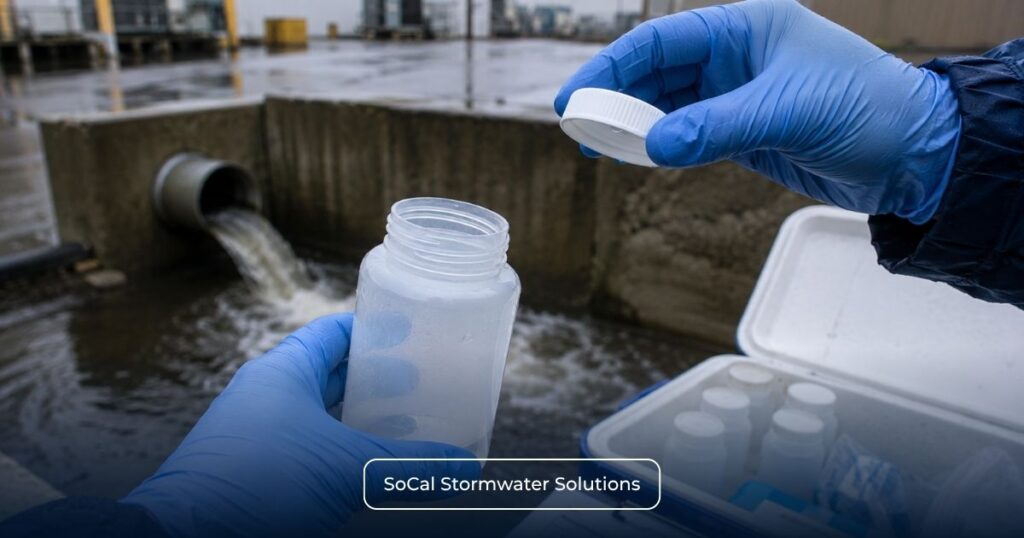
The laboratory should provide the required containers, labels, chain-of-custody forms, and preservation instructions before the storm. Unapproved containers, contact with interior surfaces, altered preservatives, or overfilled bottles can contaminate or change a result.
Attachment H requires facilities to:
- use laboratory-provided containers for grab samples;
- avoid touching the inside of the bottle or cap;
- avoid inserting objects into the container;
- avoid overfilling;
- close the cap securely;
- complete the sample label; and
- follow applicable preservation instructions.
Do not rinse a preserved container or transfer the sample through an unapproved intermediate container. Overfilling is not merely a packaging problem; Attachment H states that it can change analytical results.
Error 6: Mishandling pH and Field Measurements
pH must be measured or screened no later than 15 minutes after collection. The permitted method depends on whether the facility is subject to a Subchapter N pH requirement and whether it has entered Level 1 status for pH.
Facilities that are not subject to a Subchapter N ELG mandating pH analysis and have never entered Level 1 for pH may use wide-range litmus paper or an equivalent test kit. The screening must occur as soon as practicable and within 15 minutes.
Facilities subject to an applicable Subchapter N pH requirement must use a 40 CFR Part 136 method or a calibrated portable pH instrument. A facility entering Level 1 for pH must use one of those methods in subsequent reporting years.
When a portable instrument is used, record:
- instrument ID;
- calibration date and time;
- calibration standards;
- operator;
- calibration result; and
- relevant maintenance.
Field measurements must follow the manufacturer’s instructions. Attachment H also requires monitoring instruments to be calibrated and maintained according to manufacturer specifications.
Error 7: Breaking the Chain of Custody or Sample Identification
The chain of custody connects each result to its container, collection point, collector, time, requested analysis, and transfer history. Missing identifiers, inconsistent sample names, or absent signatures can prevent the facility from demonstrating which discharge the laboratory result represents.
The chain of custody must include:
- discharger name, address, and telephone number;
- each sample container;
- collection point;
- collector;
- date and time each container was filled;
- requested analysis; and
- relinquishing and receiving signatures.
The field log, bottle label, chain of custody, site map, and laboratory report should use consistent sample IDs. Corrections should preserve the original record and follow the facility’s document-control procedure.
Error 8: Letting Temperature or Holding Time Drift
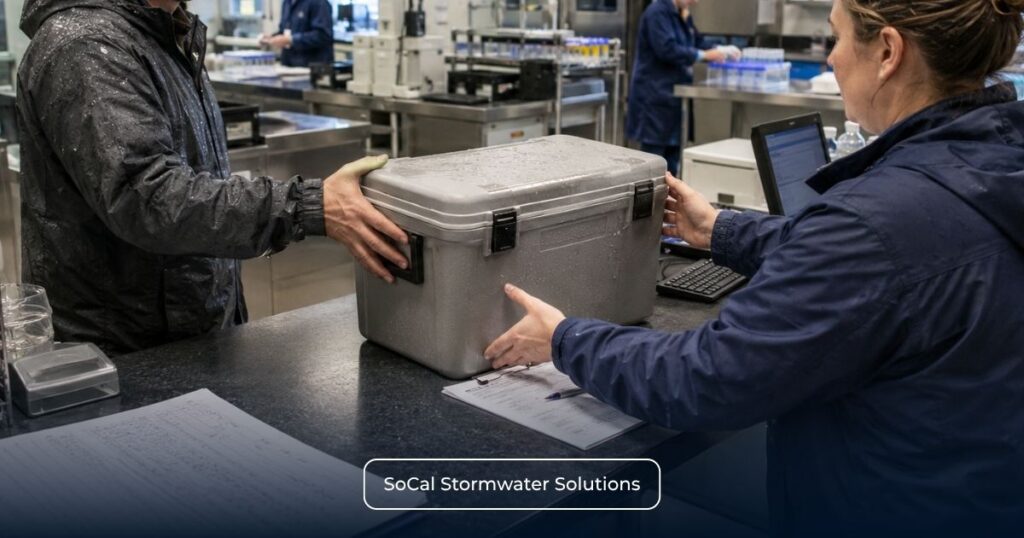
Samples must be preserved and transported according to the applicable method and laboratory instructions. Attachment H directs facilities to keep samples as close to 4°C as possible during shipment and not freeze them. This does not replace analyte-specific preservation or holding-time requirements.
Attachment H also states that the laboratory should generally receive samples within 48 hours unless the laboratory requires otherwise. This is not a universal analytical holding time. pH has a 15-minute limit, while other parameters are governed by their approved methods.
Before the event, confirm:
- preservatives;
- cooler capacity;
- courier schedule;
- weekend receipt;
- laboratory cutoff;
- parameter-specific holding times; and
- laboratory receipt documentation.
Review the final report for temperature, preservation, and holding-time qualifiers before treating the result as fully defensible.
Error 9: Ordering the Wrong Laboratory Method or Reporting Units
A generic stormwater panel may not cover the facility’s actual obligations. Required parameters can arise from statewide minimum monitoring, the pollutant source assessment, SIC code, receiving-water impairments, TMDLs, Regional Water Board direction, or federal ELGs.
The IGP minimum parameters are TSS, oil and grease, and pH. Additional parameters can be required by the facility’s pollutant source assessment, Table 1, impaired-water or TMDL conditions, Regional Board direction, or Subchapter N.
Laboratory analysis must use sufficiently sensitive procedures and applicable 40 CFR Part 136 methods unless another procedure is specified.
Confirm:
- analyte;
- method;
- MDL;
- RL or ML;
- reporting units;
- qualifier;
- holding-time compliance;
- accreditation for the analysis; and
- total-metals reporting where applicable.
The current California Environmental Laboratory Accreditation Program should be used to confirm laboratory accreditation.
Error 10: Combining Samples Without an Authorized Basis
Samples from different discharge locations cannot be informally mixed in the field. Qualified Combined Samples are combined by the laboratory in equal volumes under the permit framework and require a documented justification in the Monitoring Implementation Plan.
The process can include up to four locations when their industrial activities, BMPs, and physical characteristics are substantially similar. The justification must identify the drainage areas, discharge points, BMPs, industrial activities, physical characteristics, and similarity rationale.
Qualified Combined Samples Documentation |
|
|---|---|
| Element | Required Evidence |
| Drainage Areas | Identification and Description |
| Discharge Points | Corresponding Monitoring Locations |
| BMPs | Controls Implemented in Each Area |
| Industrial Activities | Activities Occurring in Each Drainage Area |
| Physical Characteristics | Grade, Surface Materials, and Relevant Site Features |
| Similarity Rationale | Basis for Treating the Areas as Substantially Similar |
| SMARTS Record | Certified Monitoring Implementation Plan Revision |
| Laboratory Process | Equal-Volume Combination by the Laboratory |
Combining more than four discharge locations requires Regional Water Board approval.
Representative Sampling Reduction is a separate process under §XI.C.4. Similar-looking outfalls are not automatically interchangeable under either provision.
Error 11: Treating a Non-Detect as Zero
SMARTS does not instruct users to enter zero when the laboratory reports a non-detect. The April 2026 Ad Hoc Monitoring Report guide requires the user to select the ND qualifier, leave the result field blank, and enter the laboratory-provided MDL.
When a result is below the Reporting Limit but greater than or equal to the MDL, the user selects DNQ, enters the test result, and provides both the MDL and Reporting Limit.
This is consistent with §XI.B.11, which prohibits reporting zero for a laboratory result reported as non-detect or below the MDL.
Do not manually rewrite analytical values or qualifiers to simplify averaging or status review.
Error 12: Uploading Results Late or Without the Laboratory Report
The discharger must submit sampling and analytical results through SMARTS within 30 days of obtaining all results for the sampling event. 1 The event-level Ad Hoc Monitoring Report is separate from the facility’s annual reporting workflow. For the year-end filing process, see Step-by-Step Guide to Filing Your Stormwater Annual Report in SMARTS.
The April 2026 SMARTS guide requires users to enter the monitoring location, sample information, analytical result, units, method, MDL, RL, and qualifier. It also requires analytical laboratory reports to be uploaded as “Laboratory Results.” 2
Any linked SMARTS user can prepare the report, but only an LRP or DAR with a valid eAuthorization form can certify it.
Before certification, confirm:
- correct WDID and reporting year;
- unique monitoring location;
- sample date and time;
- correct analytical units;
- analytical method;
- MDL and RL;
- qualifier;
- laboratory report upload;
- completion check; and
- LRP/DAR certification.
Facilities can use SMARTS reporting support to organize event-level records and prepare the electronic workflow while retaining their permit responsibilities.
What to Do When the Sample Is Valid and the Result Is High
A valid high result should be traced through the contributing drainage area rather than attributed automatically to sampling error. Review the parameter, field observations, industrial activities, exposed materials, spills, housekeeping records, maintenance, sediment, metals, oils, and BMP condition.
The source-tracing workflow should:
- confirm the parameter, sample ID, drainage area, and discharge location;
- review simultaneous observations;
- identify exposed materials and activities;
- examine loading, storage, maintenance, and waste handling;
- check recent spills, leaks, sediment, corrosion, and oil sources;
- inspect relevant BMPs;
- compare current conditions with the SWPPP; and
- determine whether BMP changes, SWPPP revisions, ERA activity, or another response is required.
If results meet the permit’s NAL or TNAL exceedance criteria, use the NAL Exceedance and ERA Level 1/Level 2 guide for the separate ERA workflow.
A QISP is not required for every routine sample. QISP participation becomes mandatory when the permit establishes a specific trigger. Further role boundaries are explained in The Role of a QISP in California Industrial Compliance.
What to Do When the Sample Has a Documented Data-Quality Defect
A documented defect does not automatically permit deletion, omission, or replacement of the result. Preserve the original evidence, classify the defect, and review its effect on reporting, representativeness, and potential resampling obligations.
Possible outcomes include:
- clerical error with a preserved correction trail;
- laboratory-qualified but reportable result;
- potential representativeness defect;
- missed monitoring activity;
- method or holding-time problem;
- unresolved applicability issue; or
- defect requiring qualified or Regional Water Board review.
Additional sampling may be appropriate after review, but it does not erase the original result. Attachment H also states that more-frequent sampling data collected under the permit must be reported to the Water Board.
How to Build a Pre-Storm Sampling Kit That Prevents Errors
A pre-storm kit should allow trained personnel to identify the correct point, collect the proper containers, complete field measurements, preserve custody, and transfer samples without improvisation.
Include:
- current drainage map;
- Monitoring Implementation Plan;
- assigned sample IDs;
- laboratory-provided containers;
- labels;
- chain-of-custody forms;
- cooler and ice packs;
- PPE;
- appropriate pH equipment;
- calibration records;
- visual-observation forms;
- QSE and timing log;
- laboratory contact details; and
- trained backup personnel.
Before rain, confirm required analytes, bottle types, preservation, courier cutoff, after-hours receipt, holding times, monitoring locations, and staff assignments.
What the Sample Integrity-to-NEL Exposure Control Ledger Must Contain
The final ledger should trace one result from permit applicability through corrective follow-up. Each gate should identify the requirement, supporting evidence, record owner, failure mode, review outcome, and unresolved action.
Sample Integrity-to-NEL Exposure Control Ledger |
|||
|---|---|---|---|
| Control Gate | Required Evidence | Failure Mode or Exposure | Record Owner |
| Permit Applicability | WDID, SIC, Receiving Water, TMDL, ELG, SWPPP Assessment | Wrong Benchmark or Missed NEL | Compliance Lead |
| QSE | Discharge and Preceding 48-Hour No-Discharge Record | Non-Qualifying Event or Missed QSE | Monitoring Lead |
| Discharge Point | Map, Drainage Area, Documented Location | Nonrepresentative Sample | Sampler |
| Timing | Discharge Start, Operating Hours, Collection Time | Missed Four-Hour Framework | Sampler |
| Visual Observations | Required Observations and Probable Source | Missing Field Context | Observer |
| Bottle | Container, Preservation, Label, Fill Condition | Contamination or Altered Result | Sampler |
| Instrument | Calibration, Operator, Measurement Time | Indefensible Field Measurement | Field Operator |
| Chain of Custody | IDs, Locations, Times, Analyses, Signatures | Broken Traceability | Sampler/Laboratory |
| Transport | Temperature, Receipt Time, Holding Time | Qualified or Unusable Result | Coordinator/Laboratory |
| Laboratory | Method, MDL, RL, Units, Accreditation | Incorrect or Insensitive Analysis | Laboratory Coordinator |
| Classification | Table 2, Attachment E, ELG, Reporting Year | Misclassified Result | Compliance Lead |
| SMARTS | Ad Hoc Record, Report Upload, Certification Date | Late or Incomplete Reporting | LRP/DAR |
| Corrective Response | Source Review, BMPs, SWPPP, ERA/NEL Pathway | Actual Source Remains Uncontrolled | Facility/QISP Where Required |
After completing the neutral review, facilities can consider industrial inspections and monitoring support for field sampling, laboratory coordination, result review, and follow-up based on applicable requirements.
Request a Technical Stormwater Sampling Review
SoCal Stormwater Solutions can assist with stormwater monitoring, laboratory coordination, SMARTS-ready documentation, source review, and QISP support where required by the applicable permit provisions.
For technical intake, provide the available:
- laboratory report;
- chain of custody;
- field observations;
- calibration record;
- drainage map;
- WDID;
- relevant SWPPP sections; and
- SMARTS Ad Hoc Report information.
Contact SoCal Stormwater Solutions to discuss the event and applicable monitoring or reporting needs. Technical support cannot guarantee a laboratory result, agency response, compliance determination, or enforcement outcome.