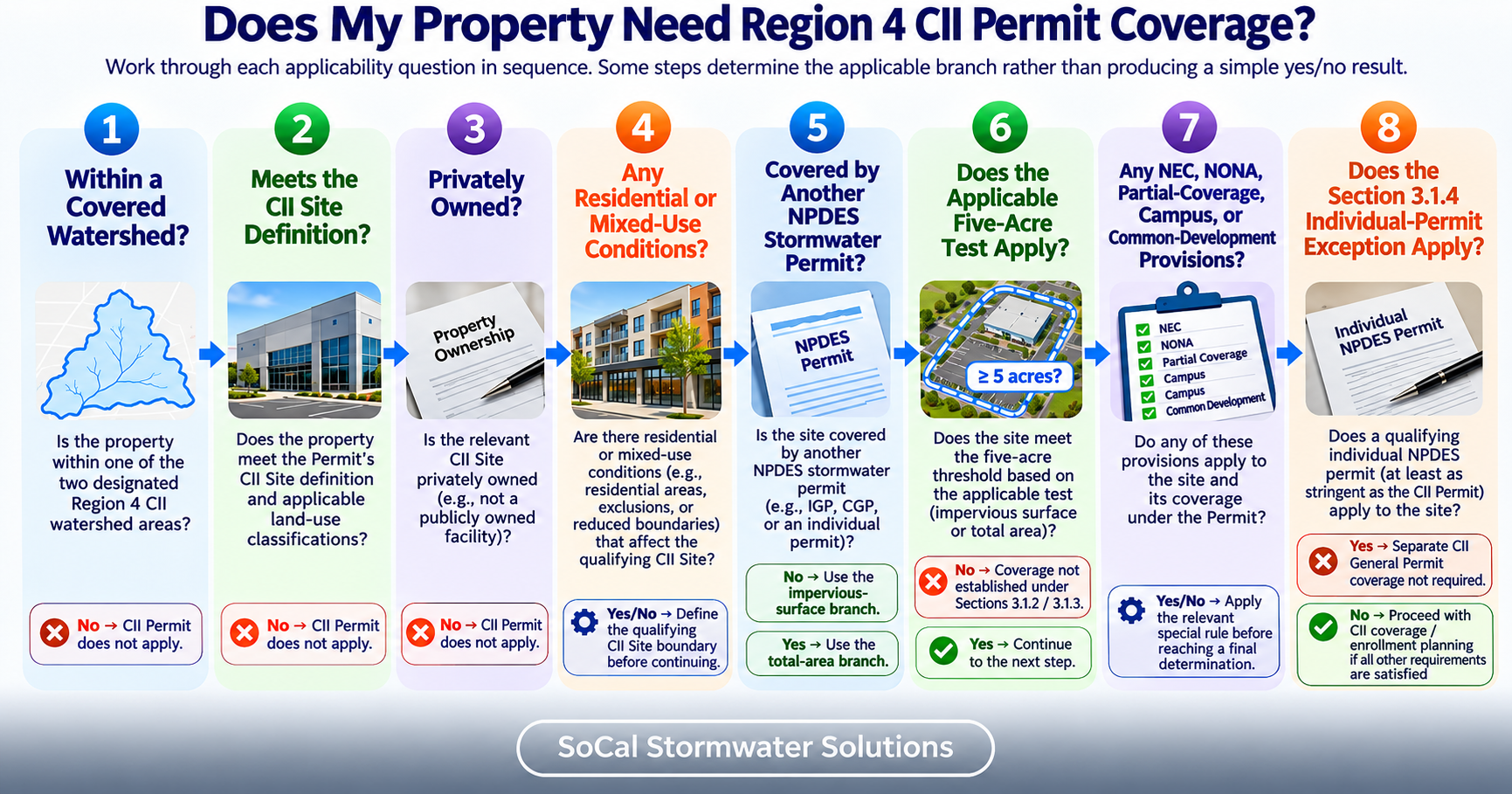
Only qualifying privately owned commercial, industrial, and institutional sites within two designated Los Angeles County watershed areas may require coverage under the Region 4 Commercial, Industrial, and Institutional Stormwater Permit. Coverage depends on several factors evaluated together: watershed location, CII Site classification, private ownership, residential or mixed-use conditions, existing NPDES stormwater status, the applicable acreage test, special parcel or permit configurations, and any qualifying individual-permit exception.
The Los Angeles Regional Water Quality Control Board adopted Order R4-2026-0226 / NPDES Permit CAS004005 on July 23, 2026. The Permit became effective on October 31, 2026, and the Water Board lists it as active. 1

TL;DR
- The Permit does not apply to every commercial, industrial, or institutional property in Los Angeles County.
- The property must be within the Dominguez Channel/Los Angeles and Long Beach Inner Harbor Watershed or the Los Cerritos Channel/Alamitos Bay Watershed.
- The relevant property must qualify as a privately owned CII Site under the Permit’s definitions and specified Los Angeles County Assessor land-use codes.
- Residential facilities are excluded. Mixed-use properties require a more specific boundary analysis.
- A qualifying site without another NPDES stormwater permit uses a threshold of five or more acres of impervious surface.
- A qualifying site covered by another NPDES stormwater permit uses a threshold of five or more acres of total area.
- An Industrial General Permit, No Exposure Certification, Notice of Non-Applicability, active Waste Discharge Identification number, or partial permit coverage does not automatically settle CII applicability.
- Contiguous parcels may define a CII Site. Campus and common-development provisions separately address how qualifying parcels may obtain permit coverage.
- An individual NPDES permit eliminates separate CII coverage only when its requirements are at least as stringent as the CII Permit.
Is the property in one of the two covered watersheds?
Geography is the first coverage gate. Order R4-2026-0226 is limited to qualifying CII Sites in:
- The Dominguez Channel/Los Angeles and Long Beach Inner Harbor Watershed; and
- The Los Cerritos Channel/Alamitos Bay Watershed. 2
A Los Angeles County address does not establish coverage. Neither does a location somewhere within Water Board Region 4. The site must be located within one of the two watershed areas specifically identified by the Permit.
Property-level screening should use the Water Board’s applicable mapping materials together with parcel, drainage, and geographic information. Where a property is near a watershed boundary, a city name, ZIP code, mailing address, or general-purpose online map is not enough to support a final conclusion.
The review should preserve the parcel information and watershed or drainage evidence used to reach the geographic determination.
Does the property qualify as a CII site?
Commercial, industrial, or institutional activity does not by itself establish coverage. Attachment A defines a CII Site as a privately owned parcel or contiguous parcels classified as commercial, industrial, or institutional under specified Los Angeles County Tax Assessor land-use codes.
The listed code ranges are:
- 1000 through 2900;
- 3000 through 3920;
- 6000 through 6910;
- 7000 through 7710; and
- 8100 through 8400. 2
The screening should confirm the Assessor Parcel Number and applicable land-use classification from current property records. The assessor code must then be evaluated together with ownership, site use, parcel configuration, and the Permit’s definitions. An assessor parcel boundary is not automatically the final CII Site boundary.
Private ownership is also part of the applicability framework. A commercial, industrial, or institutional activity on a property does not eliminate the need to confirm that the relevant CII Site is privately owned.
Where ownership and operational control are divided, the separate guide Region 4 CII Permit: Is the Property Owner or Tenant Responsible for Compliance? explains how the Permit identifies the potential Discharger.
How are residential and mixed-use properties treated?
The Permit excludes residential facilities of any type. Attachment A also establishes specific rules for parcels assigned mixed-use land-use codes 1210 and 1720.
For those mixed-use parcels:
- The CII Site includes only the qualifying commercial, industrial, or institutional portion.
- If a building contains any residential use, the entire building footprint is excluded from CII Permit coverage.
- Common areas serving both residential and non-residential uses are included under CII Permit coverage if 50% or more of the buildings on the mixed-use parcel are non-residential by area.
- Shared parking lots are subject to the same 50% test and are included when that condition is met.
A mixed-use parcel should not automatically be screened using its entire acreage as qualifying CII area. First determine the applicable CII Site boundary, including the treatment of residential building footprints, common areas, and shared parking. Then apply the relevant acreage and permit-status requirements.
Indoor operations do not independently create an exemption. The separate guide Do Indoor-Only Facilities Still Need the Region 4 CII Stormwater Permit? addresses that issue in more detail.
These Facts Do Not Automatically Mean the CII Permit Applies
- The property is in Los Angeles County.
- The parcel is five acres or larger.
- The facility has a Waste Discharge Identification number.
- The facility has an NEC.
- The facility has a NONA.
- Operations are primarily or entirely indoors.
- Several nearby parcels have the same owner.
- The property is described as commercial or industrial.
Each fact must be evaluated within the complete applicability framework.
Which five-acre test applies?
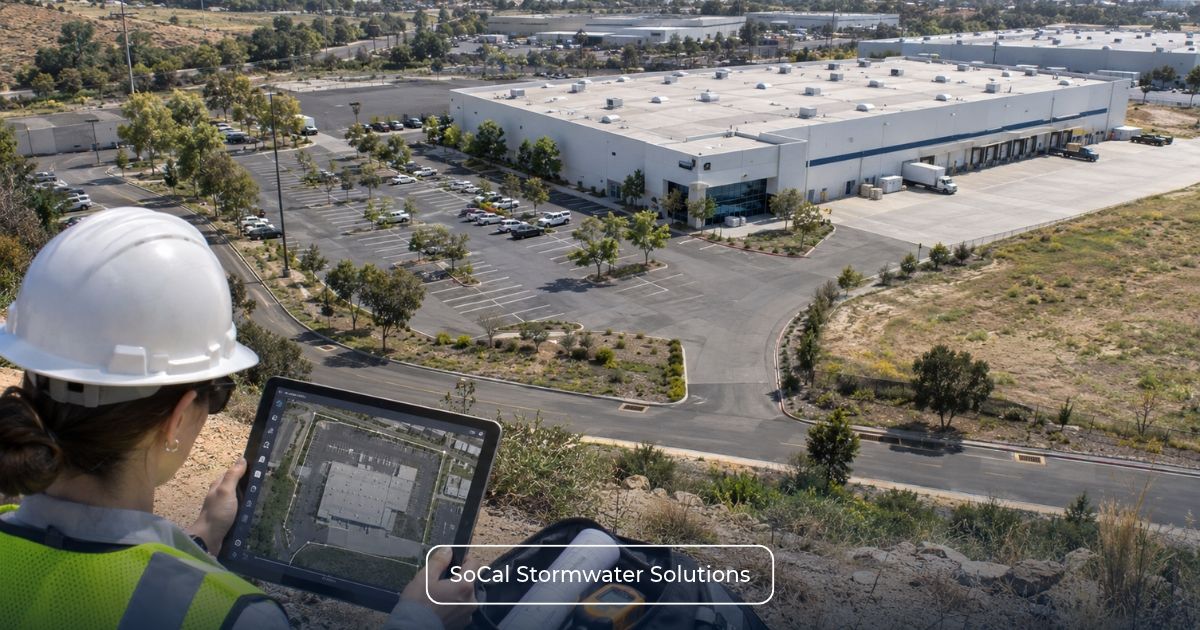
The Permit contains two different five-acre tests. The correct test depends on whether the qualifying CII Site is covered by another NPDES stormwater permit. A reference to the “five-acre threshold” is incomplete unless it identifies the site’s permit status and the type of area being measured.
The following table identifies the applicable measurement for each primary permit-status branch. Meeting one of these acreage thresholds does not eliminate the other applicability requirements.
| CII Permit Five-Acre Tests by Existing NPDES Coverage Status | ||
| Situation | Applicable Measurement | Primary Screening Question |
| Qualifying CII Site with No Other NPDES Stormwater Permit | Five or More Acres of Impervious Surface | How much qualifying impervious surface is within the CII Site? |
| Qualifying CII Site Covered by Another NPDES Stormwater Permit | Five or More Acres of Total Area | What is the complete qualifying CII Site, and what portions does the existing permit cover? |
Watershed location, CII Site classification, private ownership, mixed-use provisions, permit boundaries, and applicable exceptions must still be reviewed. 2
No Other NPDES Stormwater Permit
Under Section 3.1.2, a qualifying CII Site not covered by another NPDES stormwater permit enters the coverage analysis when it contains five or more acres of impervious surface.
Total parcel acreage is not the measurement used in this branch. A six-acre CII Site with four acres of documented impervious surface does not satisfy this acreage test merely because its total area exceeds five acres.
Covered by Another NPDES Stormwater Permit
Under Section 3.1.3, a qualifying CII Site covered by another NPDES stormwater permit uses five or more acres of total area.
Consider two otherwise similar six-acre properties in a covered watershed:
- Property A has no other NPDES stormwater permit and contains four acres of impervious surface. Its total size does not satisfy the Section 3.1.2 acreage test.
- Property B is covered by another NPDES stormwater permit and contains six acres of total area. It may satisfy the Section 3.1.3 acreage threshold even if it contains fewer than five impervious acres.
The detailed measurement methodology is addressed in Region 4 CII Permit 5-Acre Threshold: Does Your Property Need Coverage?.
What if the property already has IGP, NEC, NONA, or other NPDES coverage?
Existing Industrial General Permit (IGP) coverage, a No Exposure Certification (NEC), or a Notice of Non-Applicability (NONA) does not automatically resolve CII Permit applicability. Each status must be evaluated under the corresponding CII provision.
The current California Industrial General Permit, Order 2014-0057-DWQ as amended, remains administratively continued until a replacement permit is issued. 3
How existing NPDES coverage affects CII applicability
| Existing Status | CII Applicability Treatment |
| Existing IGP or Other NPDES Stormwater Coverage | Section 3.1.3 may apply using the five-or-more-acres-of-total-area branch. Verify the actual coverage boundary. |
| No Exposure Certification | Section 3.1.3.1 addresses CII coverage for acreage covered by the NEC when the other applicability requirements are met. |
| Notice of Non-Applicability | Section 3.1.3.2 addresses CII coverage for acreage not covered by the NONA when the other requirements are met. |
| Partial NPDES Coverage | Section 3.1.3.3 addresses the remaining portion when another NPDES stormwater permit covers only part of the qualifying facility. |
For broader existing-permit review, see Existing NPDES or IGP Coverage? When the Region 4 CII Permit Still Applies and Already Have IGP Coverage, an NEC, or a NONA? How the Region 4 CII Permit Applies.
For status-specific analysis, see How the CII Permit Applies to NONA Facilities and CII Permit Rules for Partially Covered Properties.
The Industrial Stormwater Permitting Process provides additional context for reviewing current IGP records, WDIDs, and stormwater authorization.
How do contiguous parcels and campuses affect coverage?
A CII Site may consist of a privately owned parcel or contiguous qualifying parcels. The CII Site analysis may therefore extend beyond the single Assessor Parcel Number containing the principal building. Nearby location or common ownership alone, however, does not automatically combine multiple parcels into one CII Site.
Campus and common-development provisions address a related but distinct question: how qualifying parcels may obtain and administer permit coverage.
- When one entity owns or operates a campus of multiple qualifying parcels, the owner or operator may obtain one permit covering the qualifying parcels.
- A campus may include contiguous parcels, parcels separated by an easement, right of way or public street, or another group of related parcels approved by the Executive Officer.
- When qualifying parcels owned by different entities form a common development, the owners may obtain separate or consolidated coverage. 2
These administrative provisions do not mean that every campus or common development is one CII Site. The review should first identify the qualifying parcel or contiguous-parcel CII Site boundaries and then determine whether a campus or common-development coverage structure is available.
Document ownership, operation, physical contiguity, land-use classification, existing permit boundaries, and the relationship among the parcels.
For the full parcel-configuration analysis, see CII Permit Coverage for Contiguous Parcels and Campuses.
When does an individual NPDES permit remove the need for CII coverage?
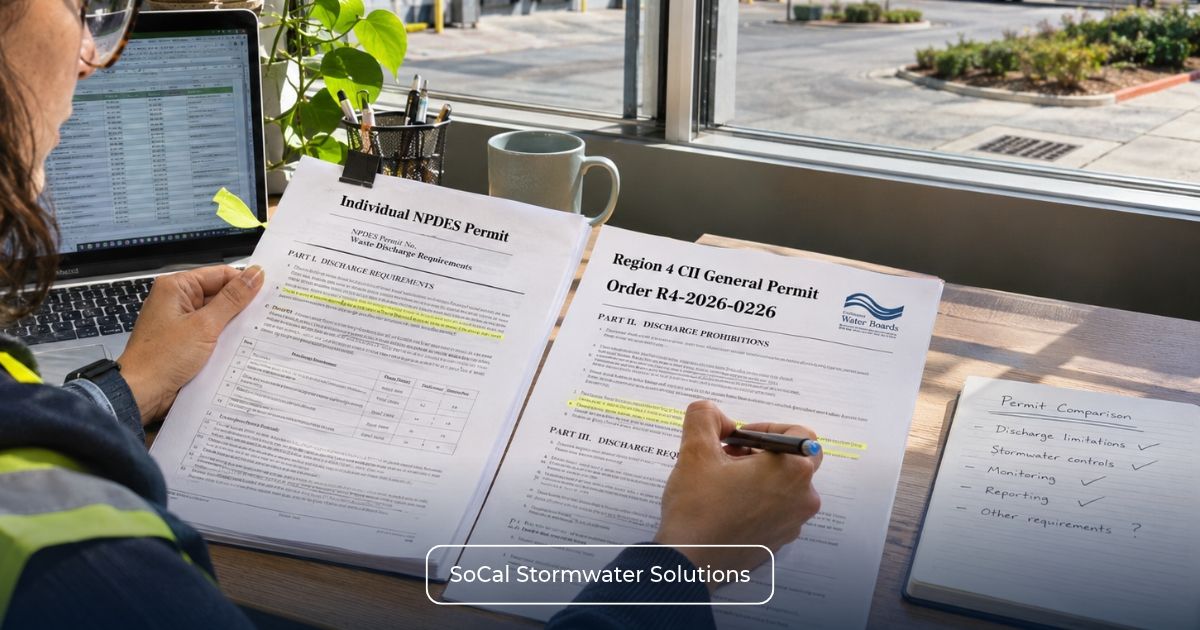
Section 3.1.4 provides a limited exception. A facility with an individual NPDES permit is not required to obtain coverage under the CII General Permit when the individual permit contains requirements at least as stringent as Order R4-2026-0226. 2
The existence of an individual NPDES permit does not prove that the exception applies. The facility should review the applicable requirements of its individual NPDES permit against those of Order R4-2026-0226 to determine whether the Section 3.1.4 stringency condition is satisfied. This assessment may involve discharge limitations, stormwater controls, monitoring, reporting, and other applicable permit obligations. An individual permit should not be treated as an automatic exemption without establishing the required level of stringency.
If that comparison does not establish the required level of stringency, separate CII coverage should not be dismissed merely because an individual permit exists.
How can a property owner or operator screen for CII coverage?
A defensible screening brings together the property, land-use, ownership, drainage, acreage, and permit information needed to evaluate all eight applicability gates. This review should occur before the facility prepares enrollment documents or commits to an ongoing compliance program.
CII Applicability Screening Checklist
Gather:
- Property address and Assessor Parcel Numbers;
- Applicable Los Angeles County Assessor land-use classifications;
- Covered-watershed location and supporting mapping information;
- Property owner, operator, and tenant information;
- Residential or mixed-use components;
- Total CII Site acreage;
- Impervious acreage;
- Current Waste Discharge Identification number and permit type;
- Industrial General Permit, NEC, or NONA status;
- Current NOI, individual permit, SWPPP, and documented coverage boundaries;
- Contiguous-parcel, campus, or common-development configuration;
- Site and drainage maps;
- Drainage areas and discharge locations; and
- The individual NPDES permit and supporting stringency analysis, if applicable.
Site and drainage conditions may require closer examination when existing permit maps or facility records no longer represent current operations. Industrial Inspections and Monitoring provides information about related field services. Any CII-specific applicability or boundary assessment should be confirmed as part of the proposed service scope.
If screening indicates that coverage may be required, the next step is to identify the applicable registration documents, responsible party, and site-specific compliance requirements. SMARTS Permitting and Application Services provides information about related administrative services.
Industrial SWPPP Services addresses existing Industrial General Permit documentation and may be relevant where the CII review must be coordinated with current industrial permit obligations. CII-specific assistance should be confirmed based on the facility and proposed scope.
To discuss stormwater permitting requirements and available compliance services, contact SoCal Stormwater Solutions with the relevant property and permit information identified in the checklist above.
Applicability screening is based on available property and permit information. It does not guarantee a particular determination by the Los Angeles Water Board.